The Third Stone
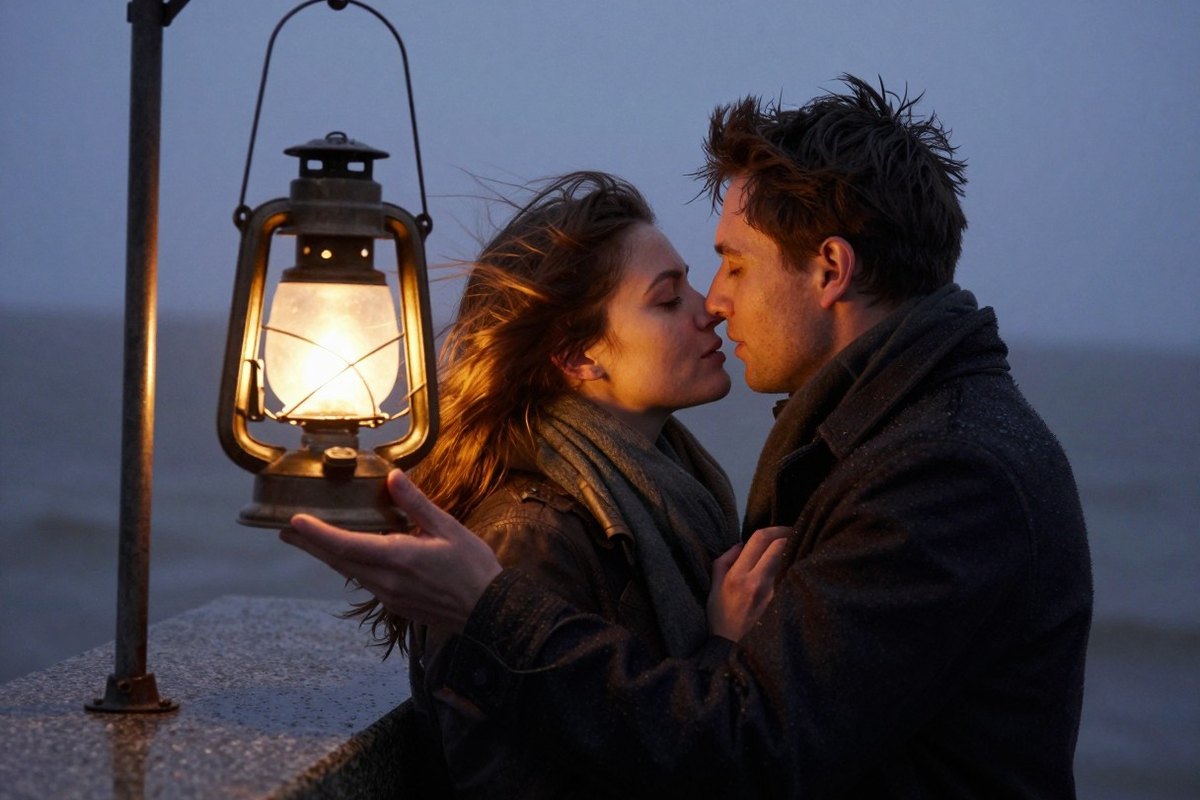
The slipway at Newlyn was not a place for easels, but Tess had claimed the third stone from the water’s edge anyway. It was November, 1890, and the Cornish light was thinning into a pale, watery grey that made her linen rags snap like gunshots in the wind. She was forty years old, her fingers stiff with cold and paint, and she was trying to capture the exact shade of slate-blue in the incoming tide before the fog rolled in off the Atlantic.
Keith stood behind her, arms crossed over a wool sweater that had seen better decades. He was the coxswain of the lifeboat station, a man built of thick rope and quiet habits, with hands scarred from hemp and a face that rarely broke into expression unless he was shouting orders to his crew. He did not speak; he only watched her adjust the canvas, his eyes narrowing at the way her stool threatened to slide on the wet granite.
He wanted her gone. He wanted the slipway clear for the crew’s morning drills, free of trip hazards and feminine chatter. But Tess was not leaving until the light failed, and she had noticed him watching her mix the ultramarine for ten minutes straight.
“Too flat,” Keith said. His voice was low, roughened by years of shouting over engine noise and breaking waves, but it cut through the wind anyway.
Tess didn’t look up from her palette. She dragged her palette knife through a streak of lead white, mixing it into the slate blue. “The horizon isn’t supposed to be dramatic, Keith. It’s supposed to be there. Like your face.”
He didn’t smile, but the tension in his shoulders dropped a fraction of an inch. “The swell is picking up from the west. You’re painting a calm sea that won’t exist by noon.”
“I’m painting what I see now,” she said, finally turning to face him. He was closer than he had been a moment ago, standing just inside the arc of her easel. The smell of him was sharp—tar, wet wool, and the metallic tang of the sea air clinging to his skin. “Besides, if you’re so worried about the swell, why are you watching me mix paint instead of checking the rigging?”
“I checked the rigging,” he said. “Then I watched you almost slip on the third stone three times. It’s distracting.”
“Distracting is good,” Tess said, wiping a smear of paint on her apron. “Keeps the mind sharp. Unlike some people who think silence is a virtue.”
“Silence is efficiency,” Keith countered, stepping fully into her space. He pointed a thick, calloused finger at the canvas. “Your perspective line on the lighthouse is off. You’ve drawn it leaning left. It’s leaning right.”
Tess blinked. She looked at the canvas, then at the distant lighthouse, then back at Keith. A slow smile spread across her face, warm and genuine, crinkling the corners of her eyes. “You noticed?”
“I notice everything that blocks my crew’s path,” he grunted, but he didn’t move away. “And I notice when you’re getting it wrong. The wind hits the tower from the east in the morning. It pushes the visual line.”
“Is that what you call it? A visual line?” Tess laughed, a bright, unburdened sound that seemed to startle the gulls off the rocks. “Keith, you are a poet. A grumpy, tar-smelling poet.”
“I am a coxswain,” he said, but his eyes held hers. The deflection was thin, transparent. He was still looking at the canvas, but his attention was entirely on her. “Fix the line, Tess. Before the fog comes in and hides your mistake.”
The fog did not come. Not yet. But the light shifted, turning the sea from slate to a bruised purple, and the air grew heavy with the promise of rain.
Tess dipped her brush, aiming for the correction. Her arm trembled, not from fear, but from the cold that had seeped through her skirts and settled in her bones. She had been out here since dawn, chasing the light, and her hands were stiff.
Keith watched her wrist. He didn’t say anything. He just stepped closer, until his hip brushed her easel, knocking it slightly askew. Tess steadied it with her knee, annoyed, but she didn’t move him away.
“Your hand is shaking,” he said. It wasn’t a complaint. It was an observation, plain and direct.
“I’m cold,” she admitted, the admission costing her more than it should have. She hated needing help. She hated that he was right. “And I’m tired. And you’re in my light.”
“I’m not in your light,” he said. He looked at the canvas, then back at her face, his gaze dropping to her hands, white-knuckled around the brush. “You’re freezing, Tess. You’ve got paint on your cheek. And you’re trying to mix ultramarine with a thumb.”
She wiped at her cheek, smearing the blue further. “I can manage.”
“I know you can,” he said. The words were quiet, rough around the edges. “But you don’t have to.”
He reached out. His hand, large and rough, covered hers on the handle of the brush. His skin was warm, shockingly so against her chilled fingers. He didn’t take the brush away. He just held her hand, his thumb resting lightly against her knuckles, steadying her.
Tess stopped breathing. The world narrowed to the pressure of his hand, the heat of him, the sudden, sharp awareness that he was touching her deliberately. He wasn’t trying to take over. He was just there, holding her steady, while she finished the line.
“Like this,” he murmured, his voice low in her ear. “Steady.”
She turned her head. He was close enough that she could feel the heat of his breath on her neck. A silent gasp caught in her throat, locking her muscles tight within his arms.
Tess looked up at him. He kept his gaze on the canvas while his jaw went hard. He was holding her hand like he was afraid she might blow away.
“Keith,” she said.
Free, no account. You will be asked to confirm you are 18 or over.
Or browse the collection