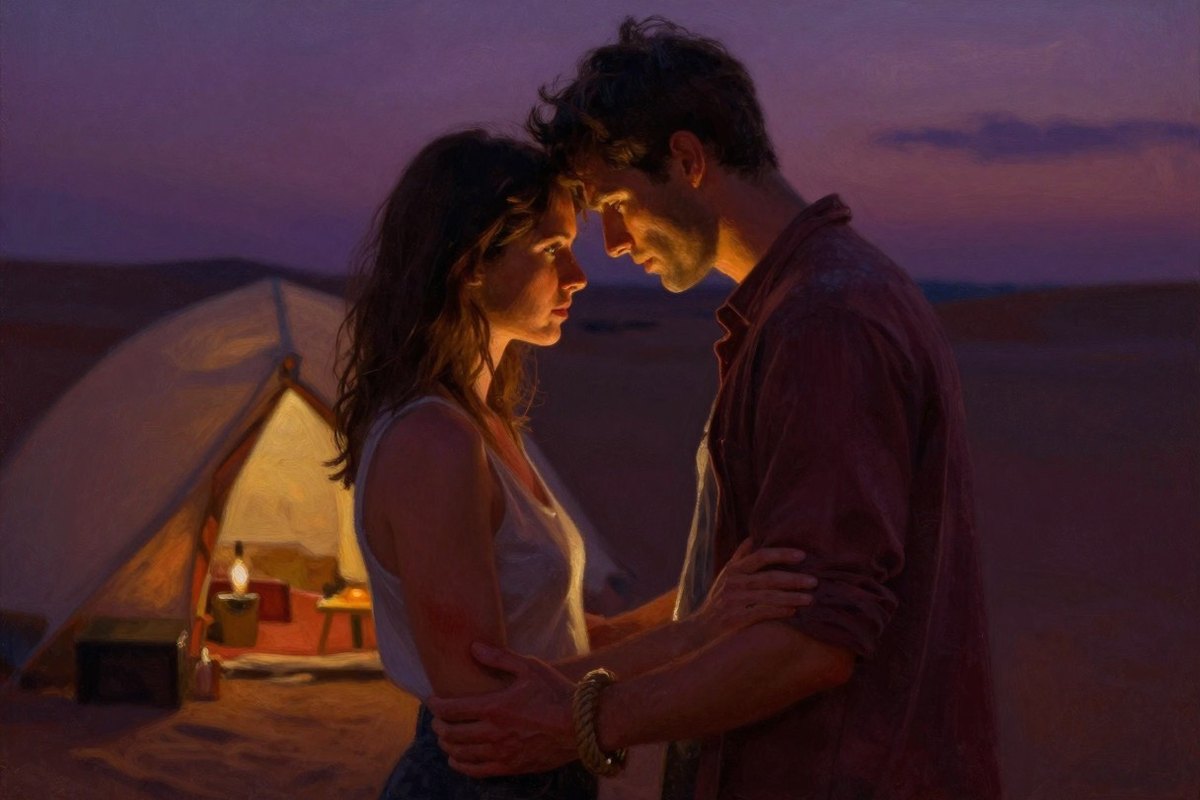
Where the Sand Ends
The sand is gone. For three days I have felt it grinding between my toes, coating my teeth, and settling into the creases of my neck, but now the ground is firm, packed earth that holds my weight without sinking. We have made camp.
Finn stands beside me, his broad frame blocking the last of the sun. He is checking the tether on the lead camel, his fingers working the knot with the quiet, exhausted efficiency of a man who has spent two months listening to the same wind. His tunic is the color of dried clay, stiff with salt and grit, and the skin of his arms is pulled tight over bone by the strain of the rope. He does not look at me. He never does. He looks at the knots, the camels, the horizon.
I watch his hands. They are large, the knuckles swollen and scarred, yet they handle the rough rope with a tenderness that surprises me. He tugs the line, testing the tension, then pats the camel’s flank. The beast exhales, a cloud of warm breath in the cooling air.
Finn finally turns. His face is all angles and weather, skin leathery and deep-lined around eyes that are the color of the sky just before snow falls. He looks at me, really looks at me, for the first time since we left Kashgar.
"You tied the last knot yourself," he says. His voice is rough, unused to sound. "Clean. Tight."
I smile, feeling the weight of the silence we have shared lift, just a fraction. "I learned from the best," I lie. I learned from a husband who died ten years ago, and from the way I watch men when I want something from them.
Finn doesn’t smile back. He just nods, once, and turns to walk toward the perimeter. The distance between us is only ten paces, but it feels like the desert we just crossed. I follow, the sand finally replaced by the hard, unyielding earth of the end.
We walk the perimeter. The ground is hard-packed earth, cracked by the heat of the day and now cooling rapidly. The sun is a bruised purple strip on the western horizon, bleeding into the deep blue of the coming night. The air smells of dried dung and sage, the scent of survival.
I keep my pace steady, matching his long strides. For sixty days, we have moved in this rhythm. He leads the camels; I follow the lead camel. He checks the water skins; I check the harnesses. He speaks only to correct a knot or shift a burden. I speak only to answer. It is a contract written in silence, and I have respected it because it was easier than wondering what a man thinks of a woman who travels with camels instead of men.
But tonight, the silence feels different. It is not empty. It is heavy, like the air before a storm.
We stop at the windbreaks, a low wall of stones and woven reeds meant to hold back the sand. Finn runs a hand along the top, checking for gaps. His tunic is pulled tight across his back. I watch the movement of his shoulder blades under the fabric. He is lean, but there is a density to him, a solidity that makes me want to lean against him and see if he will hold.
I shift my weight, trying to ignore the ache in my calves. My boots are scuffed, the leather cracked. I have worn these boots through six crossings. They know my feet. They know the rhythm of my walk.
Finn turns to me. He is holding a length of rope, coiling it with efficient, practiced movements. His eyes are on the rope, but I know he is aware of me. I have caught his gaze too many times in the last week, flicking away like a bird taking flight.
"The reeds are loose here," I say, pointing to a gap in the windbreak. "The wind will get through."
He looks at the gap, then at me. "I will fix it."
"No," I say. "I will. You have already done enough."
He pauses, the rope hanging from his hands. His gaze strips away the pretense until I am just a woman standing in front of him. It is not a casual glance. It is a study.
"I have watched you," he says. His voice is low, rough with disuse. "For sixty days."
I smile, a slow, warm curve of my lips. "And what have you seen?"
He does not answer immediately. He finishes coiling the rope, tucking it into the belt at his waist. Then he steps closer. The distance between us shrinks, the ten paces collapsing into three, then two. I can smell the sweat on him, the dust, the faint scent of leather and woodsmoke. It is a masculine smell, honest and earthy.
"I have seen you tighten the harness on the lead camel," he says. "Six times this crossing. You do it with a quiet authority. You do not force the beast. You ask it. And it obeys."
I feel a flush rise in my chest. It is not embarrassment. It is recognition. He has seen me. Not just the trader, not just the widow, but the woman who knows how to handle power.
"I learned from a good teacher," I say, echoing my earlier lie.
"No," he says. "You learned from yourself. You are strong, Becky. Stronger than you let on."
My name sounds strange in his mouth. He has never called me Becky. He has never called me anything. I am just *she*, the trader, the woman in the dust.
"Why wait until now?" I ask, stepping closer. The heat of his body radiates against mine. I can feel the pulse in his throat, beating fast against the skin. "Why wait until the last night?"
He does not answer with words. He reaches out, his hand hovering for a second before his fingers brush a strand of hair from my forehead. His touch is deliberate, tender. His thumb brushes the pulse point at my temple, feeling the rhythm of my heart.
I hold my breath. The world narrows to the point where his skin touches mine. The desert falls away. The camels, the stones, the coming night—they are gone. There is only him, and the heat of his hand, and the question hanging between us.
Free, no account. You will be asked to confirm you are 18 or over.
Or browse the collection