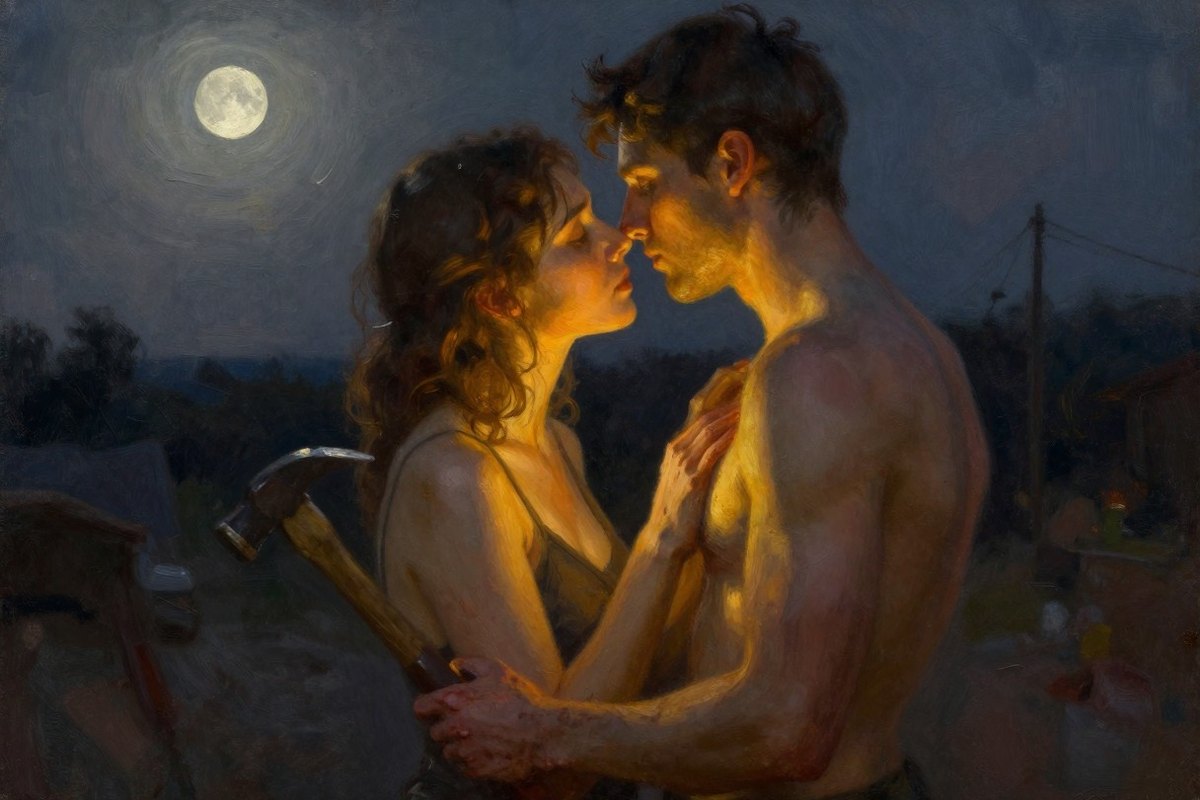
The Weight of Silence
I decided I would not wait for him to speak first.
It was a small decision, the kind that costs nothing but changes the shape of the evening. I had spent the last year of my life speaking into the dark, waiting for letters that never came, and I was tired of the silence. If Sean O’Malley wanted to be a ghost, he could haunt the other side of the village hall. I would dance with the solicitor’s son, I would drink the warm sherry, and I would leave on the Sunday morning train for Leeds with my chest empty and my future clear.
The air in the forge yard was cold enough to sting my lungs, smelling of wet coal and woodsmoke. I stood by the low stone wall, checking my reflection in the darkened window of the smithy. My hair was pinned up tight, no frizz allowed. My dress was the navy wool my mother had mended, stiff and modest. I looked like a woman who had survived France and was now prepared to survive Yorkshire.
The heavy iron door of the forge creaked open.
Sean stepped out, wiping his hands on a rag that was more oil than cotton. He was broader than I remembered, his shoulders filling out the grey work shirt until the seams pulled tight. His face was harder, the jaw set with a tension that hadn’t been there before the trenches. He carried a hammer in one hand, the head black with use, and he didn’t look at me. He looked at the fire, his eyes red-rimmed, as if he were still trying to see through smoke.
He didn’t say hello. He just stood there, listening to the bellows hiss, and for a moment, I saw the boy I had kissed in the orchard, buried under the weight of the man he had become.
The fiddle started.
It was a thin, reedy sound, cutting through the damp air of the yard. The village dance had begun inside the pub hall, where the floorboards were already groaning under the weight of boots and hope. I could hear the thud of feet, the raucous laughter of men who had not spent a winter in mud, the clinking of glass. It was a world away from the silence of the forge.
Sean finally turned his head. His gaze settled on me, stripping away the distraction until all I saw was the quiet weight of him finally seeing me. Not regret. Not apology. Just a heavy, quiet recognition.
“You’re not going in,” he said. It wasn’t a question.
“I’m waiting for the first set,” I said. “The solicitor’s son asked me. I didn’t say no.”
It was a lie, or at least a half-truth. I hadn’t said no because I wanted him to know I was available. That I was moving on. That the letter in my pocket, the one that promised me a ward of my own at Leeds General, was the only thing that mattered. But saying it made Sean’s jaw tighten. He nodded, once, and went back to wiping the hammer.
I watched his hands. They were large, scarred, stained with grease that no amount of scrubbing would remove. They were steady now. But I remembered how they looked in the photos he had sent during the war—thin, veined, trembling. I wondered if the steadiness was real or just the force of will keeping them from shaking.
The music changed to a reel, faster, brighter. I turned my back on him. I needed to be in the room. I needed the heat. I needed to feel the crowd so I wouldn’t feel the empty space beside me.
I walked across the cobblestones to the pub door. The wood was rough against my palm as I pushed it open. The heat hit me like a wall. It smelled of sweat, cheap tobacco, and boiled cabbage. The light was dim, gas lamps hissing in their brackets, casting long, wavering shadows.
I stood by the bar, ordering a glass of sherry I didn’t want. The solicitor’s son, a man named Arthur with a clean face and a nervous smile, approached me. He bowed, clumsy and eager. I smiled back, a tight, polite curve of the lips. We stepped onto the floor.
Arthur was careful. He kept his hands at my waist, his fingers light, afraid to bruise. We moved through the steps, counting in our heads. One, two, three. Turn. Step back. It was precise. It was safe. It was nothing.
I looked around the room. Sean was not there. I had expected him to follow, to claim his place, to interrupt. But he hadn’t. He was still in the yard, or inside the forge, or gone. The silence of the last year stretched between us, wide and uncrossable.
We danced three sets. My feet ached in the hard shoes. The silver pin gave way, and a heavy curl unspooled to tickle my brow. Arthur noticed. He reached up to brush it away, his hand lingering for a second too long. I pulled back, just slightly. He smiled, thinking I was shy.
I wanted to leave. I wanted the cold. I wanted the clarity of the night air.
When the reel ended, I excused myself. I didn’t wait for Arthur to offer his arm. I walked out the door, pushing through the curtain of smoke and noise, back into the chill.
The yard was empty. The bellows were silent.
Sean was leaning against the stone wall, the one I had been standing by twenty minutes ago. He held a pipe in one hand, unlit. He looked tired. The easy confidence of the blacksmith was gone, replaced by a stillness that felt fragile.
I walked toward him. The cobblestones were slick with dew. I stopped three feet away.
“You’re not dancing,” I said.
“I can’t,” he said. His voice scraped out of him, raw and unpolished.
“Why not?”
He looked at his hands. He lifted the pipe to his lips, then tried to strike a match. The match head crunched. The flame flared, bright and sudden, then died. He tried again. The match broke. His hand trembled. Just a little. A fine, rapid vibration in his fingers.
He dropped the match. He didn’t try again.
“It’s the noise,” he said. “The feet. The shouting. It’s too loud. It sounds like the shelling. I forget where I am.”
Free, no account. You will be asked to confirm you are 18 or over.
Or browse the collection