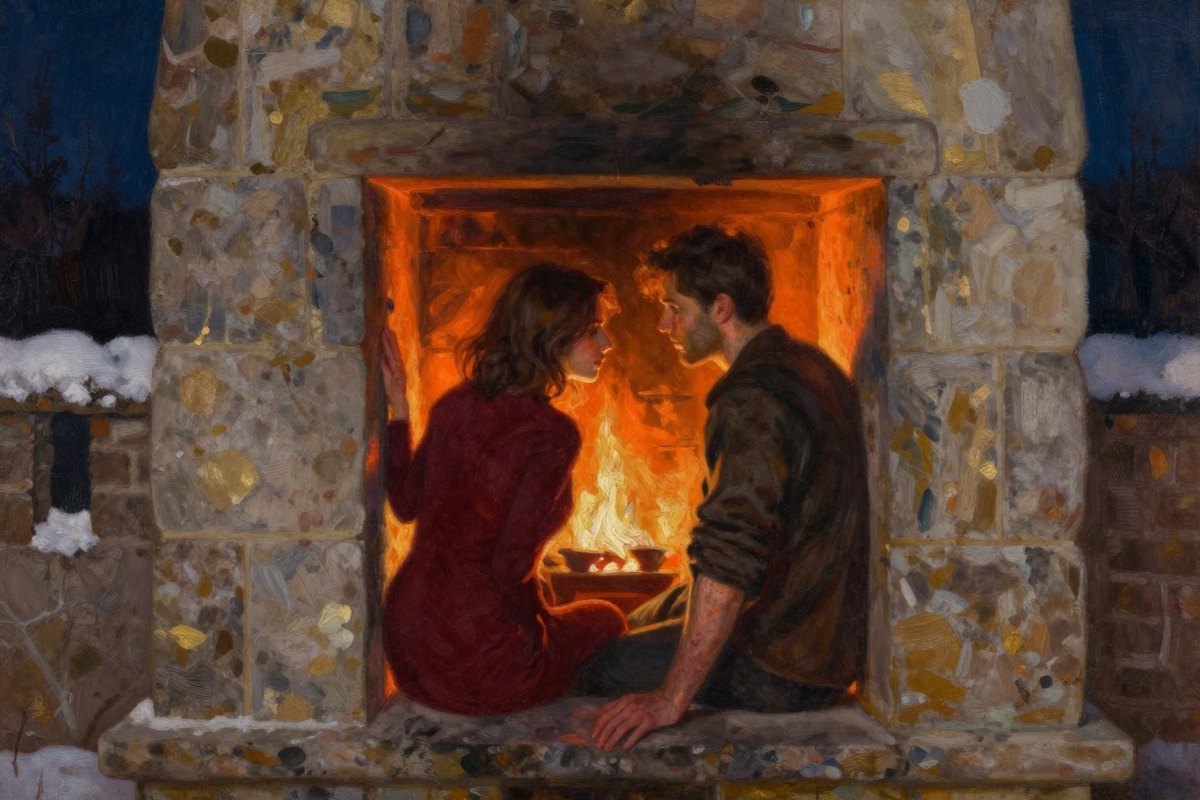
The Watchtower
The watchtower was a square of hewn granite jutting from the pass, its walls thick enough to hold back the wind but thin enough to let the cold seep through the stone like a living thing. Inside, the air smelled of pine resin, old sweat, and the sharp, metallic tang of ozone that lingered after Josh’s lightning spells discharged. The single brazier burned in the center, its heat warping the edges of the maps pinned under flat river stones on the rough-hewn floor. Outside, the snow fell in silent, heavy sheets, erasing the world until only the dark mouth of the tunnel remained visible through the arrow slit.
Harriet sat on a low stool, her knees pulled up to her chest, a woolen blanket draped over her shoulders that did little against the draft. She watched the fire, counting the pops of burning twigs to measure the time left before dawn. She was forty-two, and her joints ached with a familiar, dull protest, a map of every battle etched into her bones. She hated the cold, but she hated the silence more.
Josh leaned against the far wall, his back to the stone, sharpening his sword with rhythmic, precise strokes. He was broad-shouldered, the kind of width that filled a doorway and demanded space, his tunic sleeves rolled up to reveal forearms corded with muscle and scarred from years of holding the line. His hair, the color of wet sand, was tucked under a leather cap, though a few stray curls escaped to stick to his damp forehead. He didn’t look at her, but she knew he was listening to her breathing, the way he always did. It was a habit born of ten years of sleeping back-to-back in the mud, a reflex so deep it had become a language of its own.
Harriet reached for the tin of dried apricots she had stashed in her saddlebag, the metal cool and dented against her palm. She popped the lid, the scent of sun-baked fruit cutting through the pine and ozone, and held it out across the small space between them. It was the only sweet thing left in their rations, a luxury she had saved for this final night, though she hadn’t admitted that to herself until just now.
Josh stopped sharpening. The rhythmic *shhh-shhh* of the whetstone died, leaving only the howl of the wind and the crackle of the brazier. He looked at the tin, then at her, his eyes dark and unreadable in the firelight.
“Apricots?” he asked, a faint smile touching the corner of his mouth. It was a good smile, the one he used when he’d just pulled her out of a ravine or talked their way out of a tavern brawl. It made her chest ache.
“For the last watch,” she said, her voice sounding too loud in the small stone box. “You look like you’re about to vibrate apart.”
He took the tin, his fingers brushing hers. His hand was rough, calloused from the hilt of a sword and the reins of a horse, but the touch was gentle. He popped an apricot into his mouth, chewing slowly, his gaze fixed on hers. The silence stretched, thick and heavy, but it wasn’t the empty silence of the pass. It was the comfortable, weighted silence of ten years.
“Kael,” he said suddenly, swallowing. “Remember the arrow?”
Harriet felt a tear prick her eye, hot and sudden. She blinked it back, refusing to let it fall. “You took it in the shoulder. Complained for three days that it made your reach shorter.”
“I was right,” he said, though there was no conviction in it. “And the wyvern in the lowlands? When we ran for an hour because you forgot to check the wind direction?”
“You were the one who suggested we outrun a frost wyvern on foot,” Harriet countered, a small laugh escaping her. “I’m the captain, but you’re the bad idea.”
“You’re the one who lets me be the bad idea,” he said softly.
The words hung there, simple and true. Harriet felt the sting of unshed tears, realizing how much she missed him already. She had never been chosen first. She was the captain, the constant, the one who stayed. He was the one who moved, who signed contracts with the Iron Vow, who left.
Harriet looked down at the tin, her thumb tracing the dented rim. “I let you be it because you’re usually right about the outcome, even if the process is exhausting.”
Josh chuckled, a low, rumbling sound that seemed to vibrate through the stone floor. He reached into the tin again, pulling out another apricot, but didn’t eat it. He held it out to her.
“Take it,” he said.
She shook her head. “I’m saving them. For the road.”
“You’re not going on the road with me, Harriet.”
The statement was blunt, stripping away the polite fiction that they were merely colleagues sharing a final shift. Harriet looked up, meeting his gaze. The firelight caught the gold flecks in his brown eyes, highlighting the fine lines at the corners—lines etched by squinting into suns she had shared with him.
“I know,” she said, her voice steady despite the tightness in her throat. “The Iron Vow pays double. And they have indoor barracks.”
“They don’t have you,” he said.
The air left the small guardhouse. It wasn’t a complaint; it was a fact, stated with the same casual precision he used to call out enemy positions. Harriet felt the shift in him, the professional distance thinning until it was translucent. She had spent ten years watching his back, trusting him with her life, but she had never trusted him with this—the admission that he was leaving something essential behind.
She took the apricot from his hand. Her fingers lingered on his palm, feeling the warmth radiating through his skin, the rough texture of his calluses. It was a small contact, accidental in its appearance, but deliberate in its weight. She let her fingers rest there. The cold of the pass outside seemed to retreat, pushed back by the heat of his hand and the sudden, terrifying realization that she wanted to stay in this moment, in this small stone box, with him.
Free, no account. You will be asked to confirm you are 18 or over.
Or browse the collection