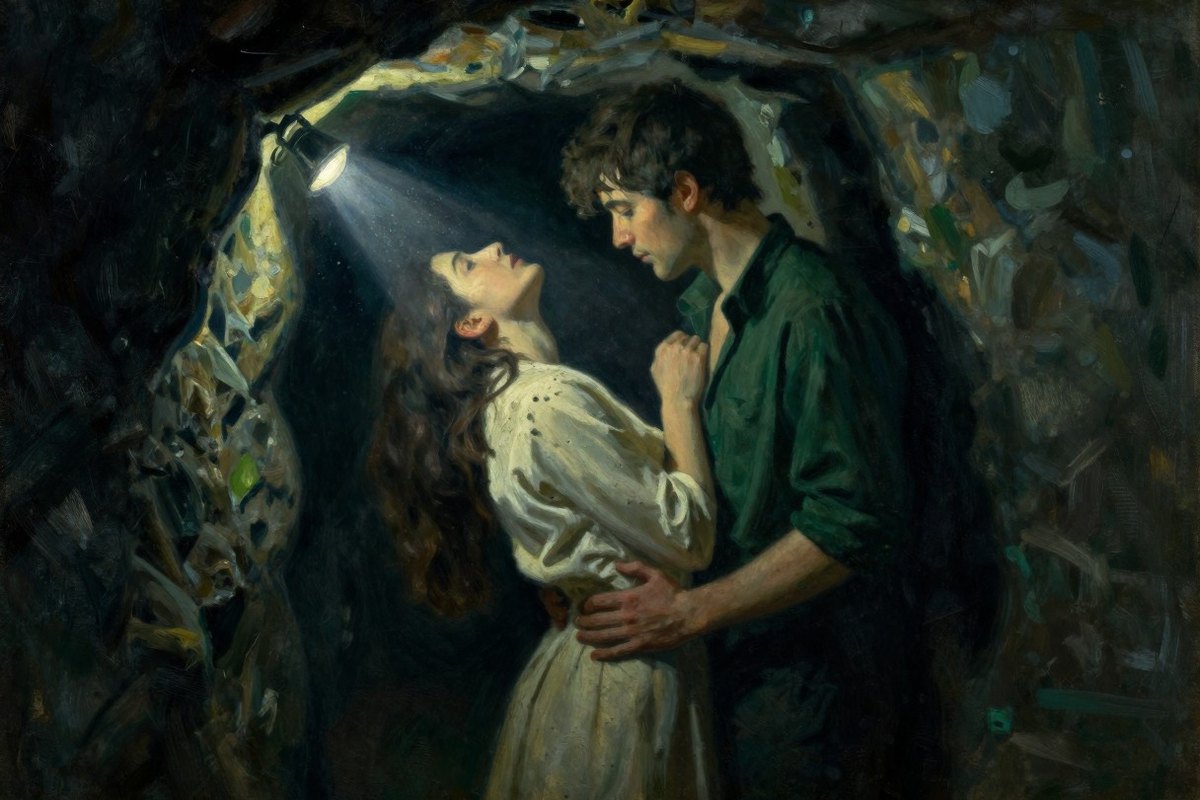
The Third Chamber
"It’s not going to stop," he said. "Not for another hour, at least."
I looked past his shoulder into the narrow shaft of the tomb. The sand wasn’t just blowing; it was pouring, a thick, gray curtain sealing the entrance to the rock-cut chamber. We were standing in the third chamber of the Tomb of the High Priest, a space we had cleared three months ago to make room for the final stratigraphic analysis. Now, it was our only dry shelter. The storm had buried the camp tents an hour ago, flattening the canvas and scattering our equipment. We had scrambled here, carrying only the water jugs and the headlamps.
Pablo stood beside me, his back against the cool, painted limestone. He was the surveyor for the dig, the man who turned our messy, intuitive excavation into clean, coordinate-based data. We had barely spoken outside of checking levels and arguing over grid squares for two years. We were married on paper, a bureaucratic convenience to share the single work visa that allowed us both to stay in Jordan for the final season. It was a transaction. Clean. Efficient.
He shifted his weight, and I noticed the dust caked into the knuckles of his left hand, a permanent stain from handling the trowels and brushes. Dark hair clung to his forehead, stiffened by the valley’s white silt. He didn’t look at me when he spoke, but his shoulders were tight, squared against the stone. He held his headlamp in his right hand, the beam cutting through the dark, illuminating the faint ochre lines of the burial inscriptions.
"I told you to take the high route back from the ridge," I said. My voice sounded flat, swallowed by the stillness of the tomb.
"I did," he said. "The wind changed direction."
The wind howled above the trench, a low, continuous roar that vibrated in the stone floor beneath us. It was a sound I had heard for seven hundred days, but here, in the belly of the earth, it felt heavier. Closer.
Pablo turned his headlamp off. The light had been catching the fine limestone powder, turning it into a swirling halo, but the darkness was better. It forced us to listen. It forced us to be present.
"Too bright," he said. His voice was rough, stripped of the polite academic cadence he used in the tent. "Saves the battery. And my eyes."
He slid down the wall until he was sitting on the limestone, his knees drawn up. He waited. I didn’t move at first. The instinct to stand, to inspect, to catalog the humidity levels of the tomb was strong. But my legs ached. The two-year dig had taken something out of me that I hadn’t noticed until the storm hit. It wasn’t just fatigue. It was the weight of being the only one who knew what the potsherds meant, who knew which layer was Nabataean and which was Byzantine, who knew that if we missed a single find, the report would be wrong.
I sat down beside him. There was no cushion, no chair. Just the hard, cool stone and the dust. Our shoulders touched. He let the contact remain. He didn’t move closer, either. He just stayed there, a solid presence in the dark.
"We close in six days," I said. The statement hung in the air, factual and final.
"Five," he corrected. "If we clear the final grid tomorrow."
"We won’t."
"Then four."
I let out a short breath. It wasn’t a laugh. It was the sound of a pressure valve releasing. "You’re right. It’s four."
We sat in the silence that followed. It wasn’t empty. It was filled with the memory of two years of shared space but separate lives. I knew his coffee order. I knew he preferred his trowels sharp enough to shave with. I knew he hummed when he was frustrated with a level. But I didn’t know him. Not really. We were colleagues bound by a piece of paper and a visa stamp.
"I’ve been watching you," he said.
The words were simple. Direct. They landed with more weight than the storm outside.
"Watching me do what, Pablo? Check the plumb bob?"
"No." He shifted, the stone grinding under his jeans. "I’ve watched you lead. For two years. Every morning, you’re the first one in the trench. Every evening, you’re the last one out. You carry the site in your head. Every decision, every risk, every doubt. You never ask for help. You never show that you’re carrying it."
I turned my head. In the dark, I couldn’t see his face, but I could feel his attention on me. It was a physical thing, a warmth against my skin.
"It’s my job," I said.
"It’s your burden," he said. "And you’re tired, Courtney. I can see it in the way you hold your brush. You’re shaking."
My hand was still. I had been holding it steady for hours, but he was right. The tremor was there, deep in the muscle, a vibration of exhaustion that sleep didn’t fix.
"I’m fine," I said. But the lie tasted like dust.
"You’re not fine," he said softly. "And you don’t have to be. Not with me."
The air between us shifted. The arrangement was clear. We were husband and wife for the paperwork. We shared a visa. We did not share a life. We did not share a bed. We certainly did not share exhaustion.
"I’m tired of being the only one in charge," I said. The words came out dry, exact. "I’m tired of pretending I have all the answers. I’m tired of holding the weight of this place together while everyone else goes home."
Silence. Then, the sound of his hand moving.
He reached out. His fingers brushed mine, resting on the stone floor between us. His skin was warm, rough with calluses from the surveyor’s chain and the trowel. He didn’t grab my hand. He didn’t clasp it. He just placed it there, an offer. A question without words.
Free, no account. You will be asked to confirm you are 18 or over.
Or browse the collection