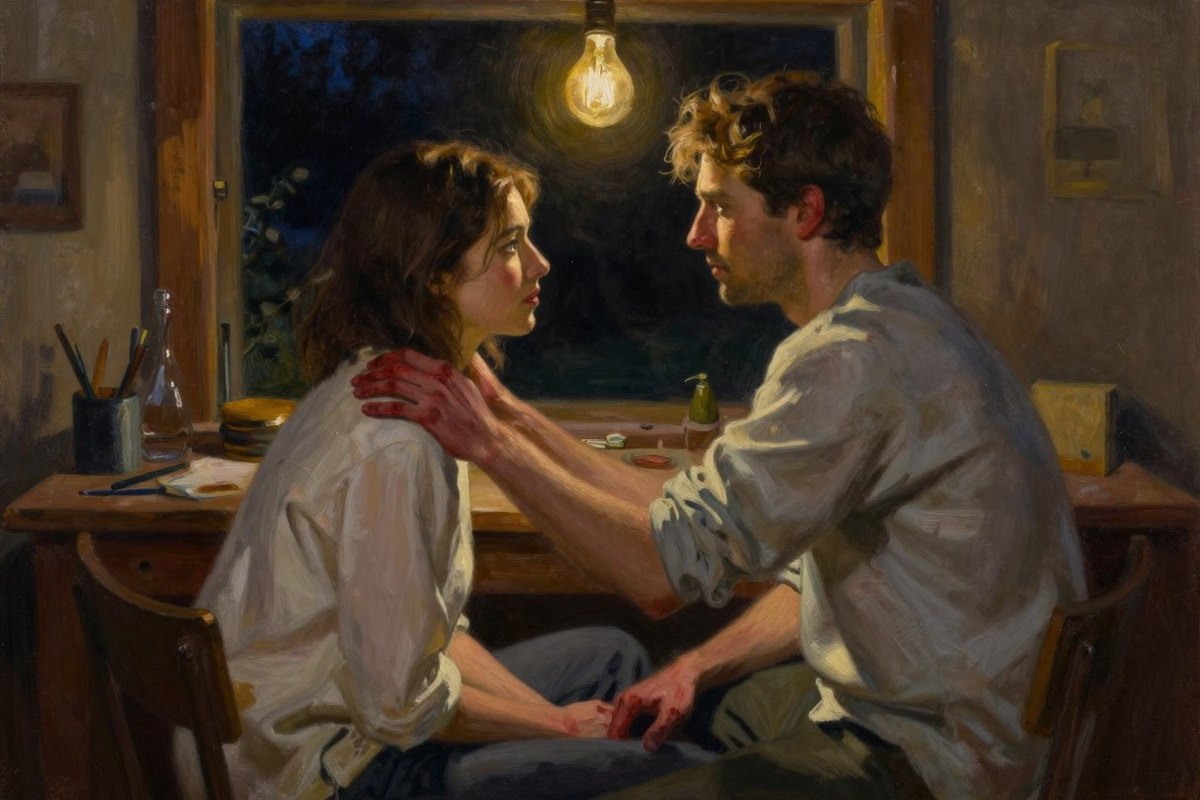
The Rust and the Rain
I am stripping the rust off a hinge with a wire brush because it is the only thing in this cabin that feels like it needs fixing, and fixing feels like progress. The brush bristles bite into the metal, sending up a fine red dust that settles on my knuckles. It is a satisfying, linear violence. Scrape. Dust. Scrape. Dust. Outside, the Michigan wind is rattling the tin roof of the cabin, a low, steady drumbeat that matches the pulse in my wrists.
The door opens without a knock. It swings inward, heavy and slow, bringing a slice of cold air and the smell of damp pine needles with it.
I don’t look up. I know the rhythm of the boots on the creaky floorboards. Heavy, deliberate. Not the frantic pace of the other volunteers, the ones who are already shouting about tomorrow’s schedule or complaining about the cold showers. This is Martin’s walk. The walk of a man who has already decided where he is going to stand before his feet leave the ground.
He stops behind me. He does not speak. He just watches the rust fall away, his breath pluming in the cone of yellow from the bulb swinging above the workbench.
"You’re going to break it," he says. His voice is lower than I remember, or maybe the room is just smaller.
I keep scraping. "It’s stubborn."
"So are you."
I stop scraping. The wire brush rests against the hinge, the metal groaning under the pressure of my grip. I turn slowly, leaning back against the workbench so I am not looming over him. He is holding two mugs. Steam curls from them in the cold air, carrying the sharp, dark scent of coffee. He must have gone to the communal kitchen, come back through the rain, and made coffee while I was here, alone, fighting rust.
"You didn’t knock," I say. It’s not a complaint. It’s an observation.
"The lock was sticking," he says. He steps into the light. He looks older than the last time I saw him in Copán, but not in a way that makes him seem diminished. The lines around his eyes are deeper, carved by sun and squinting, but his posture is the same. Square shoulders. Hands open. He is a man who occupies space because he believes he has a right to it, which is a trait I have always found either exhausting or magnetic. Tonight, it feels like gravity.
He holds out a mug. I take it. My fingers brush his. His skin is warm, dry, and solid. The contact is brief, but it sends a jolt up my arm that has nothing to do with the heat of the coffee. It is the shock of recognition. My hand knows his hand. It remembers the weight of it, the callus on his index finger from the hammer, the way he holds a tool like it is an extension of his bone.
"Black," he says.
"Two sugars for you," I reply.
"I still take two sugars."
We stand there for a moment, drinking in silence. The rain hammers the roof, a chaotic, drowning sound that seals us in. The cabin is tiny. One room. A bunk bed pushed against the far wall, a small table, the workbench I was just abusing, and a dresser. There is no hallway to retreat into. No separate rooms to hide in. If I want to leave, I have to walk past him to the door. If I want to stay, I have to stand in his orbit.
I look at him. Really look. He is wearing a flannel shirt, sleeves rolled up to the elbows, revealing forearms that are still corded with muscle but softer now, less defined by the brutal heat of Honduras. He looks comfortable. He looks like he has figured out how to be a person without running.
"Come on," he says, setting his mug on the table. He gestures toward the bunk. "We have the night. And I have a tin box."
I follow him. I sit on the edge of the bottom bunk.
He sets the heavy metal tin on the floor between our knees. It’s dented, the paint chipped away to reveal rusted steel underneath. It looks like it has survived a war. Probably has.
Martin unscrews the lid. The smell hits me first—old paper, cedar shavings, and the faint, dusty scent of tropical humidity that never really leaves fabric. Inside are polaroids, tied with a fraying red string, and a stack of letters in my handwriting. I recognize the blue ink. I remember the pen running dry in the middle of sentences.
He doesn’t pull them out all at once. He picks up a photo. The edges are white and fuzzy. In the picture, we are standing in front of a half-built wall, both of us covered in lime dust. I have my arm around his neck, laughing so hard my eyes are squeezed shut. He is looking at me, not the camera, with that open, unguarded expression that used to make my chest ache.
"You were happy," he says. It isn’t a question.
Free, no account. You will be asked to confirm you are 18 or over.
Or browse the collection