The Quarter Day Press
The fire across the close had driven the servants into the parlor, crowding the space where Amelia and Giles had spent the last month sharing a roof but not a bed. The air in the room was thick with the smell of wet wool and the sharp, metallic tang of ink that never quite left Giles’s skin. They sat in opposite armchairs, separated by the low table that held their shared plates and the ledger of their precarious livelihood.
Amelia watched him trace the rim of his tankard. He was a large man, built of dense muscle and quiet endurance, his hands scarred from burins and acid, the fingers permanently stained with the faint grey ghost of silver nitrate. He did not look at her. He rarely did when the work was done, preferring the company of his tools to the company of his wife. It was a convenience, their marriage, a contract signed in the cold light of a May morning to save her father’s press from the guild’s seizure. The terms were clear: business in the day, distance in the night.
But the distance was shrinking, though neither of them had spoken of it. The fire had stolen their separate quarters, forcing them into this single room with the sleeping household beyond the door. It was only a matter of time before the silence broke, and Amelia knew, with a sudden, sharp clarity, that she was tired of rehearsing the sentence in her head. She wanted the body to catch up with the mind, and she would not wait for him to ask.
The silence between them was not empty; it was heavy, composed of the rhythmic breathing of the housemaid on the sofa and the low, wet cough of the apprentice on the floor. Amelia shifted in the armchair, the wood creaking beneath her weight, a sound that seemed disproportionately loud in the stillness. She looked at the broadside proof spread across her lap, the paper crisp and smelling of fresh ink. It was a title page for a pamphlet on the new trade routes, a job that had kept them both awake for three nights.
"The kerning," she said, her voice sounding dry in the smoky air. "On the word *Liberty*. It feels crowded."
Giles did not look up from his tankard, but his hand stopped its tracing motion. He set the wood down with a soft clack on the table. "The type is set tight to save space on the sheet. The guild charges by the column inch."
"I know what the guild charges," Amelia said, though she did not look at him. She looked at the letters, the black shapes against the white. "But the eye needs room to breathe. If the letters touch, the word becomes a block. It becomes shouting."
She waited for him to dismiss her, as he had dismissed her suggestions on the border engraving two weeks prior. He had called it *unnecessary flourish*. She had swallowed the insult because the border was his work, her money, and their survival.
Giles shifted, leaning forward. The movement pulled the thin linen of his shirt taut across his shoulders. He reached out, not for the proof, but for the candle that stood between them. He lifted it, bringing the flame closer to the paper, illuminating the page with a warmer, more focused light.
"Look here," he said, pointing with a finger stained grey at the base of the *L*. "The counter space. It is not crowded. It is dense. There is a difference."
Amelia frowned, leaning in. The heat from the candle warmed her cheek. She saw what he meant, or rather, she felt what he meant. The tension of the letters was intentional, a visual compression that matched the urgency of the text. It was not sloppy; it was controlled.
"You adjusted the spacing," she said. "After I signed off on the galley."
"I did."
"Why?"
He paused. His eyes, dark and unreadable in the shadow of the flame, met hers. For a moment, the deference of the hired hand vanished, replaced by something sharper, more professional, and infinitely more intimate. He was speaking to her as a colleague, not a subordinate, and not yet as a husband.
"Because the galley is a draft," he said quietly. "And you read with your mind, Amelia. You see the argument. I cut with my hands. I feel the balance. The *L* was leaning left. I pulled it back."
She stared at the letter. He was right. The balance was perfect. It was a correction she had missed because she had been looking for the message, not the mechanics. A flush of heat rose in her neck, unrelated to the fire. It was the heat of being seen, of being understood in the specific, technical language that was their only common ground.
"You waited," she said. "You could have cut it yesterday. You delayed the final impression."
"I waited for you to come in," he said. The admission was casual, as if he were commenting on the weather, but it struck her with the force of a physical blow. He had held back his work, his pay, his efficiency, for the sake of her approval.
Amelia felt the terms of their contract shift, the rigid lines of *business* and *distance* blurring in the candlelight. He respected her craft. He had, in fact, been waiting for her. The realization made the air in the room feel thinner, harder to breathe.
She sat back, the proof forgotten in her lap. The noise of the household seemed to recede, leaving only the sound of his breathing and the crackle of the dying fire in the grate. Her gaze slid over the ink smudges on his knuckles and the careful set of his shoulders, landing on the steady attention he had turned on her. He was watching her, not with the patience of a husband waiting for permission, but with the stillness of a man holding his breath.
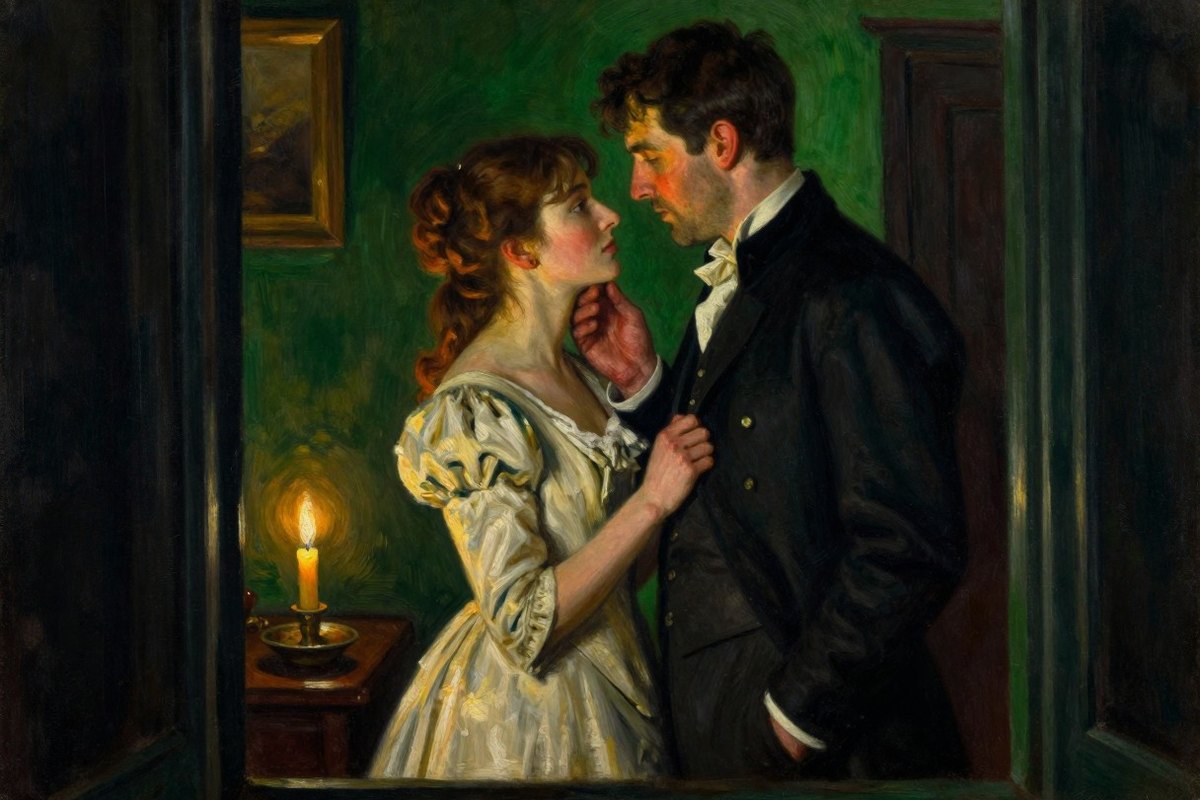
The candle flame guttered, stretching Amelia’s silhouette against the papered wall. Amelia reached out to trim the wick, her fingers moving toward the brass snuffer. Her hand passed through the space between them, the air warm and thick.
Her fingers brushed against his.
It was a small thing, a accidental contact of skin against skin, but it stopped her. His hand was warm, calloused, the knuckles rough from years of holding steel. She let the warmth stay. She felt the static charge of the moment, the sudden awareness of his proximity.
Giles did not move. He did not pull his hand back. He let his fingers rest against hers, just for a heartbeat, a silent acknowledgment of the contact. Then, slowly, he turned his face toward her. The movement was deliberate, stripping away the last pretense of casual conversation.
He looked at her face, his gaze dropping to her mouth, then back to her eyes. There was no question in his look, only a quiet, intense certainty. He reached up, his hand moving past her cheek, and turned her face fully toward his, his thumb brushing lightly against her jawline.
Free, no account. You will be asked to confirm you are 18 or over.
Or browse the collection