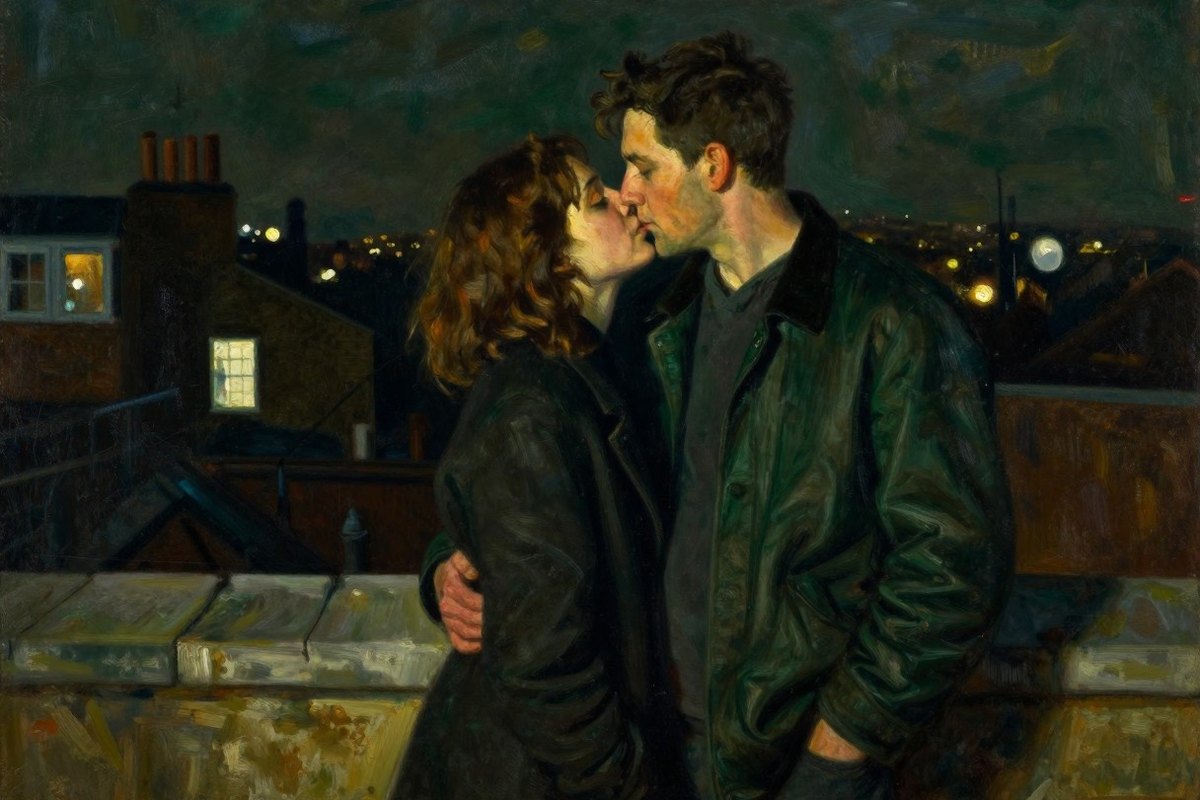
The Pause Between
The explosion stops with a sound like a heavy door slamming shut in the flat above. Then comes the silence, which is worse because it is full of listening. I am standing on the tar-paper roof of the St. John’s ambulance depot in Hackney, thirty-six years old, shivering in a wool jacket that smells of diesel and wet dog, waiting for the all-clear siren.
Glen is beside me. He has been standing there for forty minutes, his back against the chimney stack, watching the east end burn. He is a large man, built like a bricklayer with the softness of a man who has never learned to hold himself tightly. His hands are currently buried in the pockets of his fire-watch coat, knuckles white, though I cannot see them. I know the way his left thumb worries the seam of his right pocket when he is anxious. It is a habit he has had since we were nineteen and hiding in the pub cellar from his father.
He shifts, and his shoulder brushes mine. It is not an accident. He leans into me, a solid, warm weight in the cold air, and says, “It’s quiet now, Allie. Just the cooling.”
I hold my ground. I keep my eyes on the smoke rising from the warehouses in the distance, orange tongues licking the gray sky. I have a list in my head for the next hour: check the engine oil, fill the water tanks, write the report for the matron. But the list has stopped. The plan has broken.
“Don’t,” I say, my voice rough from the smoke. “Don’t do that.”
“Do what?”
“Lean on me. Like you’re trying to warm up.”
“I am cold.”
“I know. But you’re doing it on purpose.”
He turns his head. In the glow from the fire, his face is half-shadowed, the stubble dark against his jaw, his eyes bright and fixed on mine. He does not look away. He never does.
“I am doing it on purpose,” he says. He does not pull back. If anything, he settles deeper into the space I have claimed for my own shivering, his heat seeping through the layers of wool and canvas until I can feel the steady drum of his pulse against my ribs. “You’re the one who’s freezing, Allie. I’m just sharing the radiator.”
I glare at him, but the anger is thin. It’s a reflex. I have spent the last five years keeping things in their places—ambulances in bays, bandages in tins, emotions in neat, stacked columns in my head. Glen is not a column. He is a spill. He is the ink that bleeds through the paper.
“Move,” I say, but I don’t move my shoulder.
“No.”
He shifts his weight, the gravel crunching under his boots, and slides down until he is sitting on the ledge of the parapet. He pulls one hand from his pocket. It is blackened with soot, the nails trimmed short, the skin rough and cracked. He turns his palm up in the gray dusk, offering me the evidence of his day, and waits for my verdict.
“Come sit,” he says. It is not a request. It is the same tone he uses when he tells the lads to check the hoses, calm and absolute.
I want to stay standing. Standing is ready. Standing means I can jump into the ambulance if the siren wails again. Sitting is passive. Sitting is admitting that for the next twenty minutes, or however long the all-clear takes, I am not working. I am just existing.
But my knees ache. The damp has worked its way into my joints, a dull, grinding pain that I have ignored since we left the depot at dusk. And the silence is heavy. It presses against my ears, louder than the bombs were.
I sit.
I keep a foot of distance between us, the precise, polite gap of friends who have known each other since they were children and have no reason to be anything else. Sulfur and burning timber choke the air, sharp against the dry, leafy smoke clinging to his clothes. He hasn’t lit one, but the smell clings to him.
“You look tired,” he says. He is staring out at the sky, where the clouds are churning like bruised fruit, purple and yellow.
“I am tired,” I say. “I drove three sorties last night. The radiator on number four was leaking, so I had to keep topping it up with water from the cistern. My hands were numb for an hour.”
“I know.”
“How do you know?”
“Because you told me this morning.”
I frown. “I didn’t tell you this morning. I handed you the logbook.”
“You told me with your eyes,” he says, and he finally turns to look at me. In the gloom, his face is soft, the hard lines of his forehead relaxed. “You walked in, you put the book on the table, and you didn’t say a word. You just rubbed your wrists. I saw it.”
My hands are cold. I rub them together, the friction creating a tiny spark of warmth. “You see too much.”
“I see you,” he says.
The words hang there, simple and unadorned. There is no poetry in them, no grand declaration. It lands with the blunt weight of a train schedule, undeniable and unyielding. And it unsettles me more than any speech could. Because it is true. He has always seen me. Not the driver, not the planner, not the woman who keeps lists to keep the world at bay. He sees the woman who is tired. He reads my fear without looking away. At thirty-six, I am as weathered as the stones of the depot walls.
“I don’t like being seen,” I say. It comes out sharper than I intend.
Glen doesn’t flinch. He just shifts his legs, crossing one ankle over his knee. The movement brings his hand closer to mine. I watch it. It rests on his shin, the fingers slightly curled, the knuckles swollen from the cold. There is a tremor in them. A small, rhythmic shaking. I have seen it before, when the shells were falling, when he was holding the hose against the heat. But this is different. This is not adrenaline. This is exhaustion. This is the weight of the years piling up, the fear of what might happen next, the grief for the boys we haven’t seen come back.
He notices me watching. He tries to still his hand, clenching it into a fist, but the shake continues, vibrating through the muscles of his forearm.
“Glen,” I say.
“It’s nothing,” he says. His voice is rough, scraped raw by smoke and silence. “Just the cold.”
“It’s not the cold.”
Free, no account. You will be asked to confirm you are 18 or over.
Or browse the collection