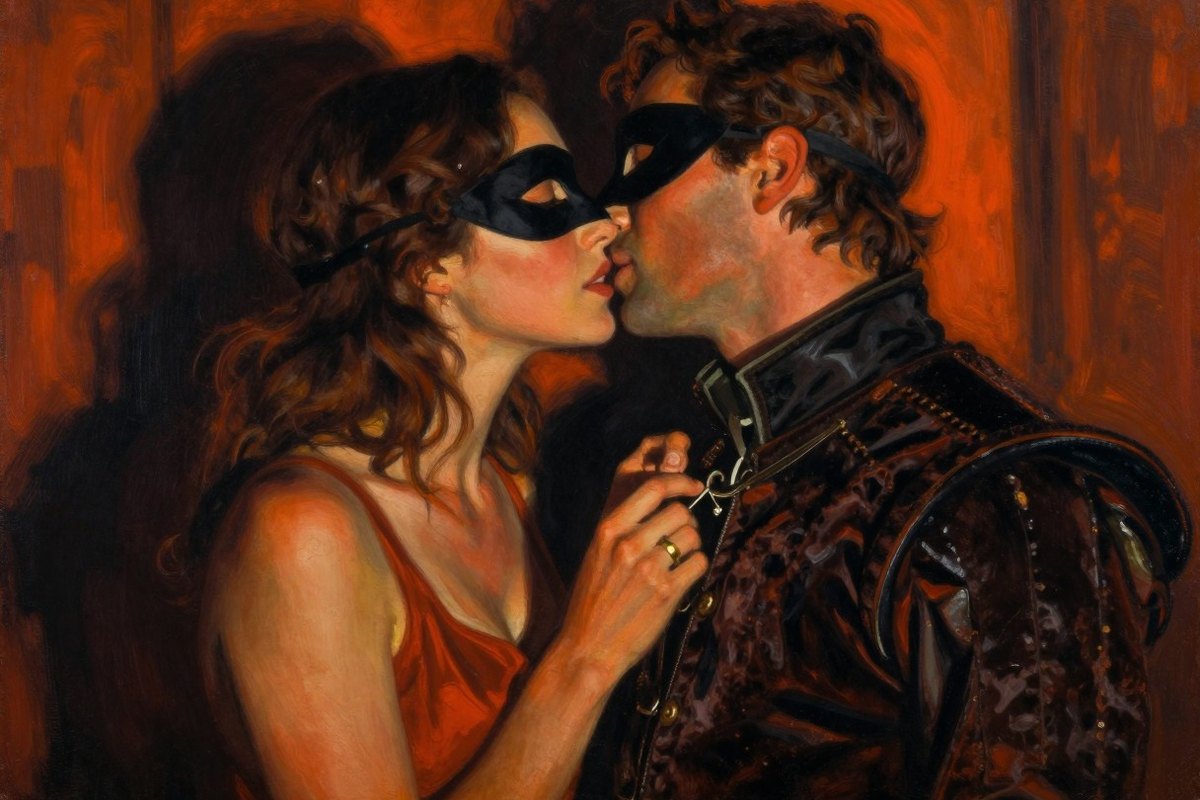
The Paper Marriage
The morning smelled of beeswax and the salt air that crept through the cracks in the shutters. I lay on his narrow cot, the sheets tangled around my ankles, and watched the dust motes dance in a single shaft of light cutting across the floor. There was no drive home, no text to send. There was only the quiet proof of him: the dark hair spread across the pillow like ink, the heavy rise and fall of his chest, and the faint, sweet scent of his sweat still clinging to my skin. I had wanted to be chosen first. In the quiet of the dawn, I realized I had been chosen, repeatedly, by a man who had spent the last six hours making sure I knew it.
I traced the line of his shoulder, remembering how he looked when the mask came off. He was not the elegant phantom who had stood guard at my door for three years. His shoulders were wide and solid, the skin of his arms rough from handling the family’s ironwork, and his jaw held the stubborn set of a man who had spent three years watching my back. His hands, usually so steady with a blade, had been shaking slightly as they touched my face. He had a habit of rubbing his thumb over his wedding ring—a simple band of gold he never took off, even in the bath. It was a small, human flaw in a man who projected such rigid control. I pulled the sheet up, the memory of his laugh echoing in my mind, and waited for the sun to fully burn away the night.
The sun had not fully won the day when I slipped out of his cot, the sheets cool against my bare legs. I did not look back. To look back was to invite a conversation about feelings we had not yet agreed to have. I dressed in the silence of his room, finding my corset laced tight enough to keep me upright but loose enough to breathe. I checked my reflection in the small, tarnished hand mirror on his washstand. My hair was a tangled cloud of curls, my lips swollen, my cheeks flushed with a heat that had nothing to do with the Venetian spring. I looked like a woman who had been thoroughly claimed. I liked that. It was a rare thing for me, at thirty-nine, to look used and pleased in the same breath.
I stepped out into the courtyard, the damp air biting at my skin. The canal below lapped against the stone, a rhythmic, indifferent sound. I walked back across the cobblestones to my salon, the heavy oak doors groaning shut behind me. The house was quiet, the servants still asleep or attending to the morning’s first duties. I went to the gilded mirror in my dressing room, the one that showed me my true age, my tired eyes, the fine lines that had begun to map themselves around my mouth. I touched my cheek, feeling the lingering warmth of his hand.
I reached into my bodice, my fingers brushing the rough paper of the marriage contract. It was still there, folded neatly, a shield against the Inquisition. But shields were heavy, and I was tired of carrying one that did not protect my heart. I took the contract out, smoothing it on the table. The ink was dry, the signatures firm. *Polly and Stuart.* It was a legal fiction, a necessary lie. But the lie had a taste now, like salt and beeswax, like the sweat on his skin.
I heard the bell ring, sharp and insistent. Not the soft chime for a client, but the heavy toll for a master. I knew that sound. I smoothed my skirts, checked my powder, and waited. The inquisitor was coming tonight. The verification was not a suggestion; it was a threat. If they found no evidence of our union, the contract would be void, my house seized, and I returned to the obscurity of a common courtesan. I had to prove it. I had to make it real.
I walked to the door, my pulse fluttering like a trapped bird against my ribs. I opened it.
Stuart stood there, masked in black velvet, his posture rigid, his eyes dark behind the silver half-mask.
He did not step inside. He never did. He stayed in the threshold, a dark column against the gray light of the hallway, his sword belt creaking softly as he shifted his weight. The mask hid everything but his eyes, and even then, they were hard, unreadable things.
"Good morning, signora," he said. His voice was lower than I remembered, roughened by sleep or the night’s air. "The inquisitor arrives at dusk."
"I know," I said. I leaned against the doorframe, crossing my arms over my chest to keep my bodice in place. "That is why I opened the door."
He looked at me. Really looked. It was a heavy attention, the kind that made my skin prickle. He was studying my face, not with the hunger of a client, but with the precision of a man checking for cracks in stone.
"We have a contract," he said. "We do not have a history. The inquisitor will ask for proof. He will look for signs of intimacy. Disarray. Scent. Heat."
"I am thirty-nine, Stuart," I said, letting a small, tired smile touch my lips. "I am quite good at looking disarrayed. But I prefer not to lie if I can help it."
He tilted his head. "Lying is easy. Being convincing is harder."
"Then let us be convincing." I took a step back, into the room. The floorboards groaned. "Come in. Close the door. Show me what you intend to do."
He hesitated, just for a second. A flicker of uncertainty in his eyes, or perhaps respect. Then he stepped across the threshold. The heavy oak clicked shut behind him, sealing us in the dim, lavender-scented quiet of my bedroom. He turned to face me, his hand rising slowly, not to touch me, but to hover near my waist.
"Is this acceptable?" he asked.
Free, no account. You will be asked to confirm you are 18 or over.
Or browse the collection