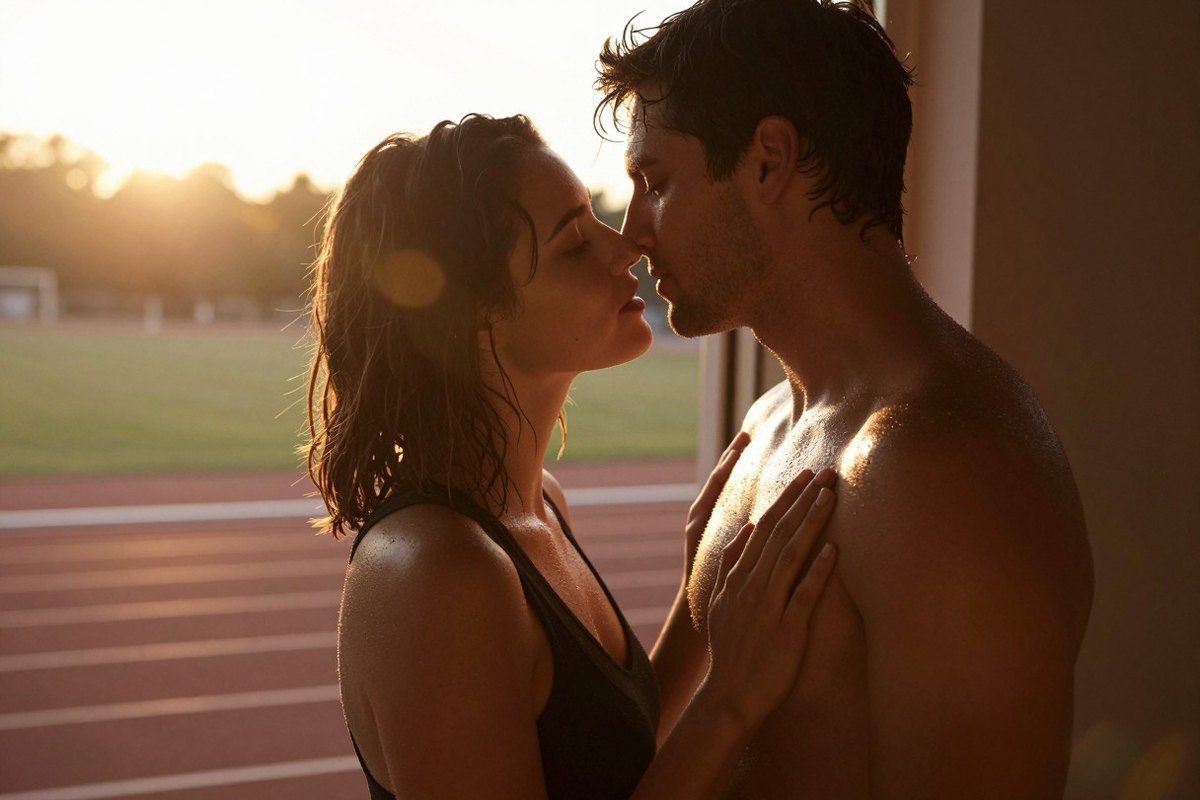
The Pacer’s Rhythm
The next morning, the sun was already high over the Queensboro Bridge, turning the East River into a sheet of hammered silver. We sat in the quiet of his sedan, the engine off, listening to the metallic ping of the cooling block sync with the heavy, wet rush of the East River below. Vikram’s hand rested on the center console, fingers tracing the rim of a discarded energy gel wrapper. I looked at the draft text on my phone—*That was efficient. Thank you.*—and deleted it. It wasn’t efficient. It had been messy, loud, and entirely unscripted. We hadn’t spoken since we’d collapsed onto his couch three hours prior. I didn’t know if we were still registered partners or just two people who had found a new rhythm, but the space between us felt different. Charged. I wanted to reach out and cover his hand with mine, to see if the heat would travel, but I kept my hands in my lap.
Sunday began at 4:30 a.m., in the gray, vibrating belly of the starting corral in Central Park. The air held the sour bite of cold sweat from ten thousand strangers. I stood near the back of the pacers’ section, shivering in my technical shirt, checking my watch for the third time in a minute. My lungs felt tight, not from exertion, but from the weight of the small velvet pouch in my running belt.
"You’re breathing like you’re already running," a voice said.
I looked up. His height forced me to crane my neck, the neon-green vest stretching tight across his back as he stood rigid against the crowd. His face was calm, composed, with eyes that scanned the crowd with a practiced, unblinking focus. He held a water bottle in one hand, the knuckles white, a telltale sign of tension he was clearly trying to suppress. He didn’t look like a man who enjoyed chaos. He looked like a man who managed it.
"I’m Jenna," I said, my voice sounding thin against the roar of the starting horn warming up. "You’re my pacer?"
He nodded, extending a hand. His handshake was a brief, deliberate anchor. "Vikram. And yes. I’m here to keep you on pace, Jenna. And to keep you upright."
“Upright is a low bar,” I said, pulling my hand back. I adjusted the strap of my running belt, feeling the small velvet pouch shift against my hip. “I’m forty-six, Vikram, not eighty. I have good bone density.”
He didn’t smile. He looked at my shoes, then at my shins, assessing the muscle definition with the detached precision of a mechanic checking an engine. “Bone density doesn’t matter if your form breaks at mile twenty. That’s when people die. Metaphorically. Usually.”
The horn blared, a single, sharp note that cut through the murmur of the crowd. The mass of runners ahead of us shifted, a tidal wave of nylon and breath.
“Are we registered?” I asked, the question feeling stupid the moment it left my mouth. We were standing next to each other. We were wearing the same color vest. It seemed obvious.
“For the charity waiver, yes,” he said. He reached into his pocket and pulled out a laminated card. “The TCS rule for ‘scattering companions’ requires a registered pair. A friend counts, but the form needs a name and a relationship status. I put down ‘Partner.’”
I looked at the card. *Jenna Miller & Vikram Singh. Status: Partner.*
“Partner,” I repeated. “Not friend. Not colleague.”
“Partner implies a shared objective,” he said. He stepped closer, invading the small circle of personal space I usually guarded with ferocity. The air between us felt suddenly thick, charged with the static of ten thousand waiting bodies. “And it allows for physical contact without looking like I’m harassing a stranger. If you hit a wall, I can grab you. If you cry, I can hold you. It’s efficient.”
“I don’t plan to cry,” I said, though I felt a prickle of heat rise up my neck. The lie was thin. The pouch at my hip felt heavier, a dense anchor of grief I hadn’t yet learned how to carry while moving at six-minute miles.
“Good,” he said. “Then we stick to the pace. I will lead. You follow. You do not look at the crowd. You look at my back. If I stop, you stop. If I slow, you slow. Do you understand?”
His voice was low, a command wrapped in cotton. It wasn’t a request. It was a structure. And for the first time that morning, my mind, usually a chaotic library of over-analyzed scenarios, went quiet. I liked the structure. I liked the idea that someone else was holding the map.
“I understand,” I said.
The starting gun fired.
The gun fired.
We moved. Not with the explosive panic of the front pack, but with the steady, rhythmic surge of the pacers. I locked my eyes on the back of Vikram’s vest, on the black number pinned to the fabric, and let my body fall into the cadence he set. In-out, in-out. The city was a blur of noise and color, but inside the bubble of his pace, there was only the mechanics of breathing and the slap of rubber on asphalt.
We hit the bridge into Manhattan. The wind picked up, cold and sharp, cutting through the thin layer of sweat already forming on my back. My lungs burned, a familiar, sharp sting that I usually welcomed as proof of life. Today, it felt like an intrusion.
“Left foot,” Vikram said, his voice cutting through the roar of the crowd without raising in volume. “You’re dragging.”
I adjusted, feeling the slight correction in my stride. He didn’t look back. He didn’t need to. He could feel the shift in the air, the tiny deviation in my rhythm. It was unnerving. It was perfect.
Free, no account. You will be asked to confirm you are 18 or over.
Or browse the collection