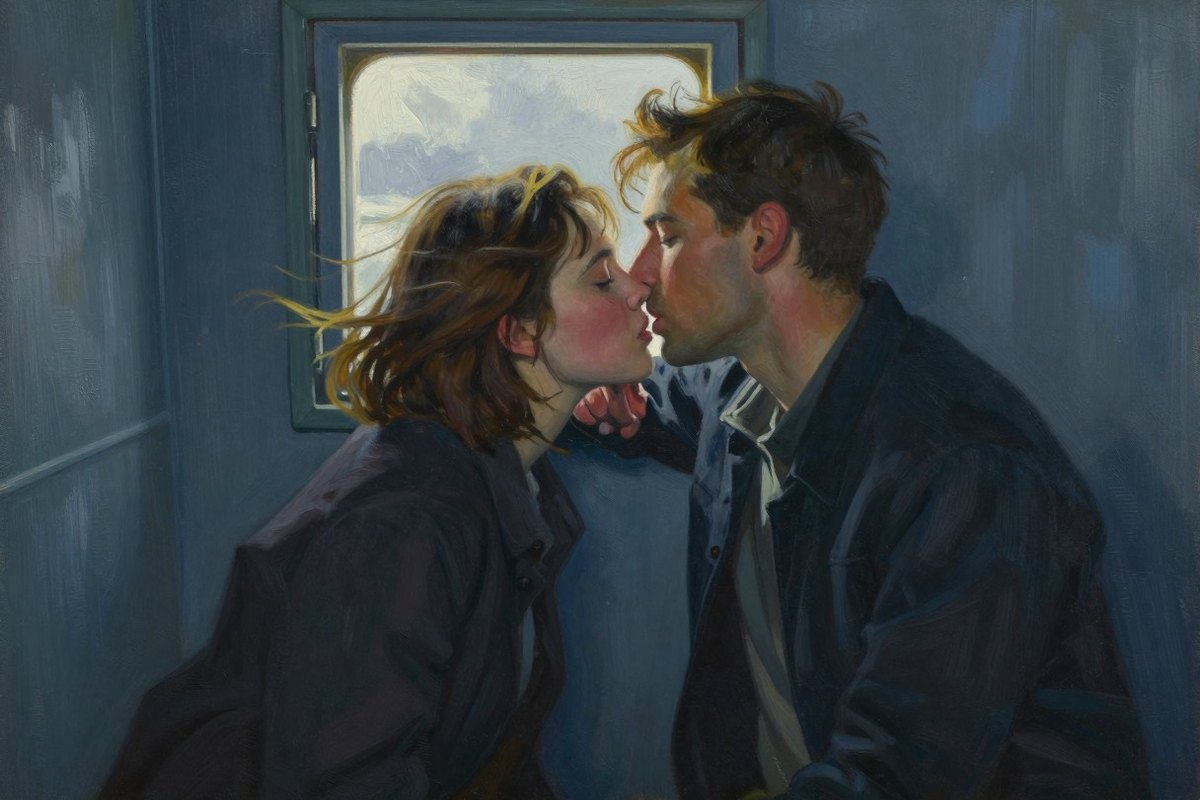
The License
I decide, right then, that I will not let the wind make me feel small.
It is a Tuesday decision, practical and sharp, the kind you make when the barometer drops and the sky turns the color of a bruised plum. The *Mary Ellen* is tied up tight at the wharf, her lines humming like guitar strings, but the cabin above the gear locker is already feeling smaller, the air thick with the smell of diesel and wet wool. I have three days of storm ahead. I know this because Tomas knows this, and he has already moved the ladder against the wall so I don’t have to climb up and down with the coffee pot.
He is standing by the porthole, watching the water pile up against the pilings. He is a big man, built for leverage, with forearms that look like they could snap the halyard if he decided to stop being careful. His hands are salt-crusted, the joints swollen from years of hauling nets, currently resting on the sill with a patience that usually annoys me. He doesn’t turn when I speak, but his shoulders shift, the heavy canvas of his work shirt pulling tight across the back. He knows the wind has come round. Everyone in Lunenburg knows. But he stays because the license is in my name, and the license is only valid if he is my husband, and the marriage is only valid if we are both here, breathing the same damp air.
"Three days, Clara," he says. His voice is low, cutting through the rattle of the window frame. He finally looks at me, and his eyes are dark, steady, and entirely unafraid. "We check the nets. We check the fuel. We stay dry."
"I don't need a babysitter, Tomas."
"No," he agrees, pushing off the sill. He walks toward me, and the floorboards groan under his weight. "You don't."
He moves past me to the workbench, not with the hesitation of a man respecting a boundary, but with the easy, occupying presence of someone who already belongs in the space. The cabin is cramped, a single rectangle of pine and plywood that smells of cured tobacco, old salt, and the sharp, metallic tang of the bilge pump running below. There is nowhere to hide, and I have no desire to try.
We begin the inventory. It is a ritual we have performed a hundred times, but usually, it happens in the wide, windy silence of the deck. Here, compressed by the storm, the routine feels intimate, almost deliberate. I pull a coil of three-strand line from the rack, checking the knots for fraying. He is on the other side of the narrow table, organizing the tins of bait. The space between the bunk and the table is tight enough that our knees occasionally knock together, a dull thud that neither of us acknowledges.
"Check the cleat on the starboard rail," I say, my voice sounding too loud in the small room.
"I did," he replies. He doesn’t look up from the tin he is wiping clean with a rag. "It’s rusted. I’ll grease it when the wind dies."
"Good."
I move to the shelf above the stove, reaching for the extra flannel shirts we keep for the crew, though there is only us. My hand brushes against a folded bundle at the back. I pull it forward. It is my old shirt, the navy blue one I wore for five years before I sold my last house and bought the *Mary Ellen*. The cuffs are frayed, the elbows patched with a darker shade of blue. I remember losing it in a laundromat in Halifax, thinking it gone forever.
I look at Tomas. He is stacking the tins, his movements efficient, his back to me. I unfold the shirt. It smells like him—sandalwood and rain and the faint, sweet scent of the fish processing plant where he sometimes takes odd jobs. He hasn’t just kept it; he has washed it. He has mended the loose thread on the collar.
It is a small thing. A trivial kindness. But in a marriage of convenience, where terms are written on a license and signed with a pen, objects don’t linger unless they are chosen. He could have tossed it. He could have given it back when I thanked him for the paperwork. Instead, he kept it. He kept it close.
I fold the shirt again, tucking it under my arm. The realization hits me with the same sudden, sharp clarity as the decision I made about Tuesday. He isn’t just here for the license.
The wind outside shifts, a low groan against the shingles that vibrates through the floorboards and up into the soles of my boots. I hold the shirt against my chest, feeling the weight of the cotton, the evidence of his attention. We have spent two years sharing a boat, a bunk, and a legal fiction, keeping our lives in neat, parallel lanes. He is the muscle; I am the mind. He is the warmth; I am the stone. It was efficient. It was safe.
But safety is a luxury you can’t afford when the sky is falling, and I am tired of being efficient.
I look at him. He is still facing the table, shoulders broad and relaxed under his grey henley, the fabric stretched tight across his back. He knows I am looking. He has always known. That is the thing about Tomas; he does not pretend to be blind. He sees the fraying knot, the rusted cleat, the woman standing in his cabin holding his laundry.
"Tom," I say.
He stops wiping the tin. He doesn’t turn immediately. He lets the silence stretch, just for a heartbeat, letting the question hang in the air between the bunk and the workbench. Then he turns. He turns, catching my gaze with a look that holds mine without blinking. There is no surprise in them, only a quiet, waiting recognition.
"I know," he says. His voice is low, roughened by the days we’ve spent talking over the roar of the diesel.
Free, no account. You will be asked to confirm you are 18 or over.
Or browse the collection