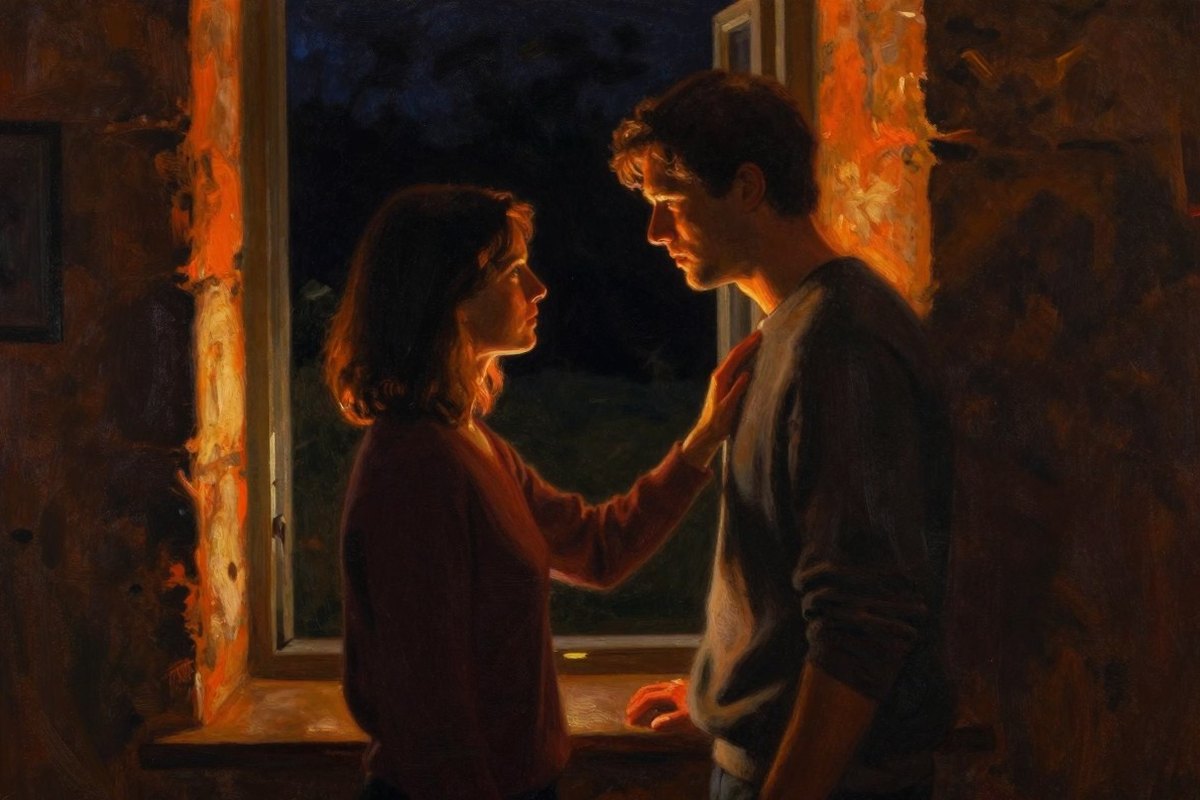
The Lecture Tomorrow
I decide, right then, that I will not apologize for the four years I spent pretending I didn’t know him. I will stand at the podium tomorrow morning, deliver the lecture on late Victorian trade routes that my supervisor died before he could finish, and I will not look for Ben in the front row. I will not seek his approval. I will not ask if he remembers how I took my tea.
The Old College is breathing its last sighs of the day. The air in the corridor is still and smells of damp stone and old paper. I hear the heavy iron gate clatter shut at the bottom of the yard, the sound final and metallic, sealing us inside. The porter has gone. The lights in the hallways are dimming, sector by sector. I am trapped in the building with the man who knows the exact shape of my silence.
I turn the corner toward the common room. He is already there, leaning against the window frame, looking out at the darkened quad. He has filled out since Boston. The lean, nervous energy of his early thirties has been replaced by a solid, heavy quiet. He is wearing a sweater that has seen too many washes, the wool pilled at the elbows, and his hands are resting on the sill. They are large hands, the knuckles scarred from years of handling books and coffee mugs, the nails cut short and practical. He doesn’t turn when I enter. He just shifts his weight, a small, grounding adjustment, and lifts the glass to his lips. He knows I am here. He has always known when I was coming.
I walk to the sideboard. The crystal decanter of single malt sits beside a bowl of ice that is already sweating, melting into a shallow puddle on the wooden surface. I pour two fingers into a tumbler. The liquid is amber and thick. I do not offer him a drink. He hasn’t moved from the window.
“We need to agree on the sequence,” I say. My voice sounds flat in the large, empty room. “I take the first slot. The Victorian trade routes. You follow with the colonial administrative structures. It flows logically. Cause and effect.”
Ben turns then. His gaze strips me bare, and the air thins. He sets his glass down on the sill without a sound. “It flows,” he says. “You always did like linear narratives.”
“I like clarity.”
“Clarity is a luxury. History is rarely clear.”
He steps away from the window, moving into the pool of yellow light cast by the floor lamp. He is closer than he needs to be. I can smell the rain on his wool sweater, the faint, sharp scent of the peppermint oil he used to keep in a tin on his desk. I remember that tin. I remember reaching for it when my head throbbed after three hours of grading papers, and him handing it over without looking up from his book.
I take a sip of the whisky. It burns, a clean, hot line down my throat. “The sequence is set, Ben. Unless you have a better proposal.”
“I don’t.” He stops three feet from me. “But I have a question.”
“Save it for the Q&A.”
He smiles, but it doesn’t reach his eyes. “You left without a word, Wendy. No email. No note. Just a box of books and an empty chair. Boston didn’t send a memo. Why?”
I set my glass down on the sideboard. The ice clinks. “I had a grant. A tenure track. It was the logical next step.”
“Logic.” He repeats the word as if it tastes bitter. “You took my copy of *The Making of the Modern World* with you. The one I annotated. I noticed it was gone the next morning.”
My hand tightens around my glass. I didn’t realize I was holding it that tightly. “I borrowed it.”
“You kept it for four years.” He takes a step closer. The space between us shrinks. I can see the stubble along his jaw, the slight dark circles under his eyes. He looks tired. He looks good. “I wondered if you hated it. If you hated the annotations. If you hated me.”
“I didn’t hate you,” I say. The admission hangs there, naked and unnecessary. “I hated the leaving. And I hated that I knew you’d wait.”
He doesn’t blink. He just looks at me, his dark eyes fixed on my mouth, then my eyes. The air in the common room feels heavy, saturated with the weight of four winters I spent in a city where the sun barely broke the clouds.
“Did I?” he asks. His voice is low, rough around the edges.
“You waited,” I say. “You kept my chair empty for a week. You didn’t invite anyone else in.”
“I was hoping you’d come back for your coat.”
“It was a cheap coat. From Primark.”
“It was the one you wore when you were cold. You always got cold.”
Free, no account. You will be asked to confirm you are 18 or over.
Or browse the collection