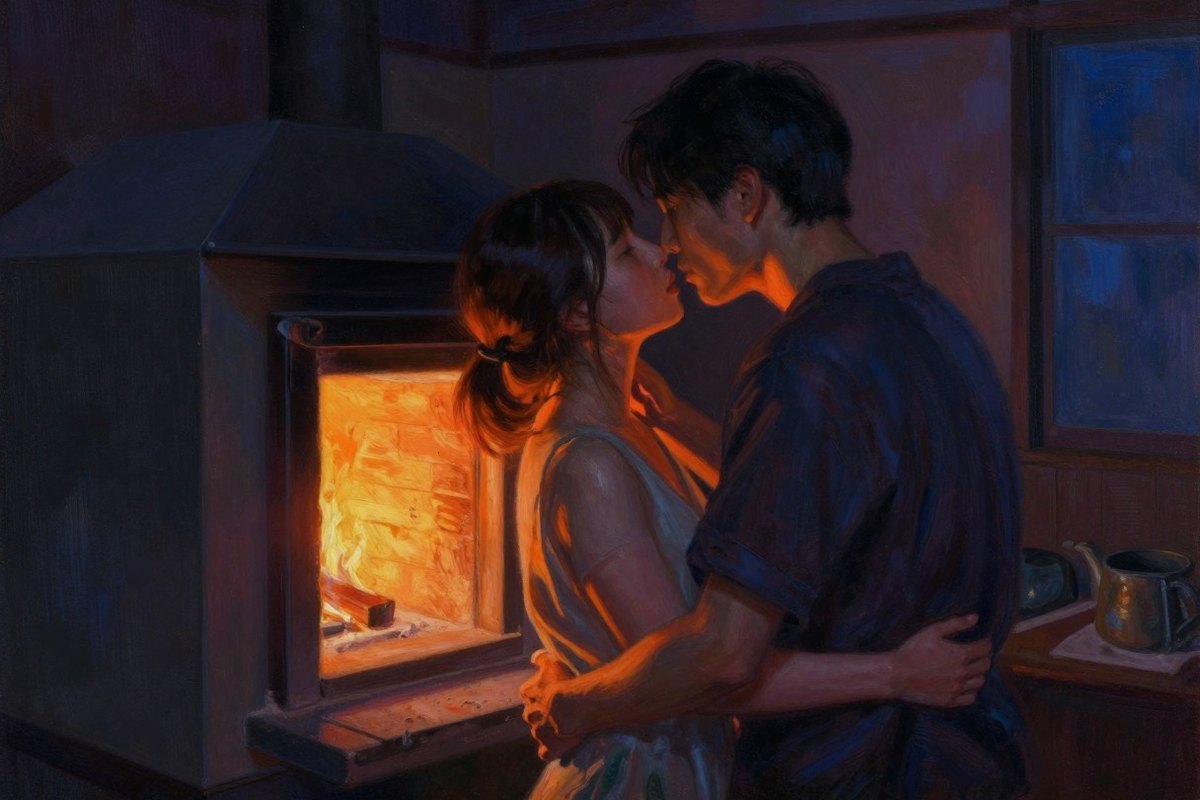
The Final Firing
The clay is cold and heavy in my hands, a stubborn lump of stoneware that refuses to center. I press my thumbs into the spinning mass, feeling the grit of the grog against my skin, trying to force it into symmetry before the wheel wobbles and throws my whole piece off-axis. My knuckles are white. If I don’t get this base even, the whole vase will crack in the final firing, and I have nothing left to show for three weeks of silence in Kyoto.
I’m focused on the friction, the heat building in my palms, when a shadow falls across my workbench.
“You’re squeezing it too hard, Nic.”
Barry leans against the doorframe of my studio, shutting out the gray afternoon glow. He is wearing a flannel shirt with the sleeves rolled up to his elbows, revealing forearms mapped with old scars and fresh wood dust. He holds two paper cups, steam curling from the tops in the cool air. His hair is a messy dark curl that looks like he’s just run his hands through it, and there is a smudge of walnut stain on his left cheekbone that he hasn’t bothered to wipe away.
I stop the wheel. The clay settles with a soft thud.
“I’m not squeezing,” I say, though I know he’s right. I’ve been fighting the clay instead of guiding it. A habit born from a lifetime of trying to control things I can’t.
He steps closer, the floorboards creaking under his boots. He doesn’t ask if I want the tea. He just sets one cup on the edge of my wet shelf, careful not to disturb the drying bats. His movements are deliberate, unhurried. He watches my hands, still stained grey, before looking up at my face. His eyes are warm, amber-brown, and they hold a kindness that feels too generous for a man I’ve known for only ten days.
“Drink,” he says softly. “We have a long night ahead.”
I lift the cup. The paper is hot against my palms, a small, dry heat compared to the damp chill of the clay on my fingers. I take a sip. It’s sweet, too sweet, probably green tea with too much sugar, but it cuts through the metallic taste of exhaustion in my mouth.
“You’ve been here since six,” Barry says. He doesn’t look at me; he’s watching the wheel, as if he can still see the ghost of the vase I’m trying to force into existence. “And you haven’t eaten.”
“I’m fine,” I say. It’s the lie I tell everyone. It’s not a lie about my hunger; it’s a lie about the weight of the silence. In Leeds, my studio was loud with the clatter of my sister’s kids and the hum of the bus route outside. Here, in this converted machiya in the Higashiyama district, the silence is a physical thing. It presses against my eardrums. I came here to work, to escape the noise of being a daughter, a sister, a friend. But the silence has its own volume.
Barry nods, accepting the answer without pushing. That’s the arrangement. We are partners in name only. I lied on the residency application because the single-artist studios were booked out six months ago. The shared spaces, the ones with the better kiln access and the larger workbenches, required a duo. I needed the space. I needed the kiln that didn’t have a three-week waiting list. So I emailed Barry, the woodworker in the next room who had been kind enough to lend me a chisel when mine snapped, and I asked him to pretend. He said yes. He said it was easier than finding a new neighbor.
For ten days, we have been polite ghosts. We nod in the hallway. We exchange pleasantries about the humidity. We do not touch.
“The kiln,” Barry says finally. “It’s time.”
I look at my watch. 7:45 PM. The final firing starts at eight. If we miss the window, the wood won’t burn hot enough to mature the glaze. My pieces—twelve vases, six bowls, all of them fragile and full of mistakes I hope the fire will forgive—will come out raw. White and dull. Useless.
My stomach tightens. The kiln is old, a wood-fired anagama style built into the hillside behind the complex. It’s temperamental. It doesn’t have a digital thermostat. It has a fireman’s eye and a fireman’s heart. And it needs two pairs of hands.
“One to feed the wood, one to watch the spy holes.”
I set the cup down on the edge of the wheel, careful not to smear clay on the rim. The wheels are already spinning in my head, a low hum of anxiety that has nothing to do with the machine in front of me. I need to be at the kiln. I need to be competent. I need to not look like a woman who lied her way into a room she wasn’t sure she belonged in.
Barry picks up my cup and carries it to the sink. He moves with that easy, unhurried grace that irritates and calms me in equal measure. He’s tall, broader in the shoulders than he lets on, and there’s a sawdust smell clinging to his flannel shirt that is somehow cleaner than the metallic tang of the clay.
“Do you want to start?” he asks, turning off the tap. He dries his hands on a rag, his eyes meeting mine. They are dark, warm, and entirely unjudging. “Or should I?”
“I’ll start,” I say. My voice sounds thinner than I want it to. “You watch the peep holes. If the flame turns blue, tell me to back off. If it turns white, tell me to push.”
He nods. “Understood.”
We walk out the back door, leaving the cool, dim light of the studio for the humid night air of Kyoto. The kiln climbs the slope in rough-hewn stone segments, its loading arch gaping wide to swallow the night. The fire is already lit, a small, orange heart beating in the darkness.
I kneel before the opening. The heat hits me first, a dry, heavy blanket. I pick up a piece of seasoned pine, splitting it with my hands to expose the fresh, white wood inside. I slide it into the throat of the kiln. The flames lick at it, hungry and eager.
“Good,” Barry says. He is standing beside me, close enough that I can feel the radiating heat of his body, separate from the fire. “Keep a steady rhythm. Don’t let it breathe.”
Free, no account. You will be asked to confirm you are 18 or over.
Or browse the collection