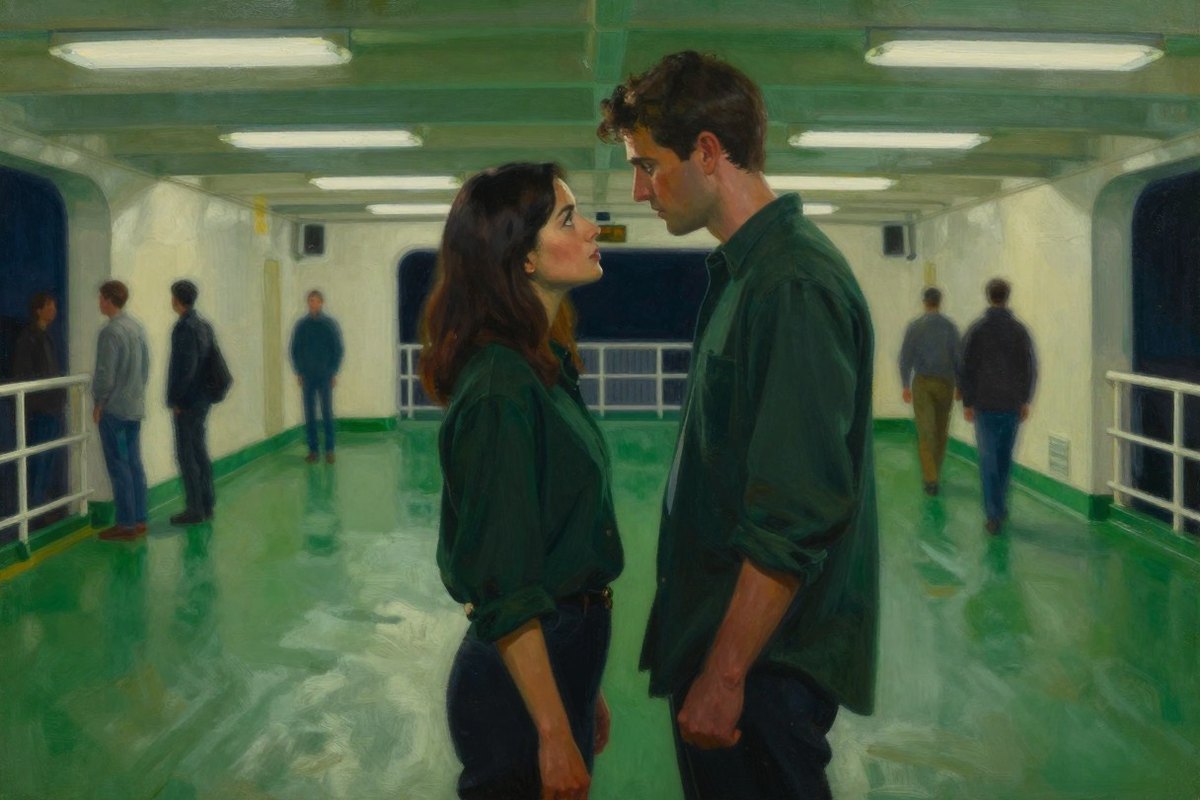
The Cancelled Crossing
There were four reasons she took the Friday night ferry from Holyhead, and they were all equally boring. One: it was the only direct route to Dublin that didn’t involve a three-hour drive through traffic that made her teeth ache. Two: her mother lived in a flat with a view of the River Liffey and a heating system that worked, which was a luxury Rhiannon had stopped expecting at forty-five. Three: the wine on board was cheap, and the sea air cleared the fog of a week spent managing other people’s expectations. Four: Luca.
He was there, as he always was, in the same seat in the lounge, reading the same kind of book. He was broad-shouldered, with forearms that looked like they could crush a walnut or hold a woman steady, depending on the occasion. His hair was dark and unruly, sticking up in the back as if he’d been running his hands through it for hours. He wore a wool sweater that had seen better days, the elbows frayed, the color a deep, faded charcoal. He didn’t look up when she entered. He never did. He just turned a page, the sound crisp in the quiet hum of the lounge, and nodded when their eyes met. It was a ritual. A year of nods. A year of silence. A year of wanting to say something, anything, and deciding that the nod was safer.
But tonight, the nod wouldn’t happen. The ferry wasn’t happening.
The announcement came not as a voice, but as a vibration in the floorboards, followed by the sharp crackle of the intercom. *“Ladies and gentlemen, the crossing to Dublin is cancelled due to high winds. We apologize for the inconvenience.”*
Rhiannon didn’t look up from her phone. She knew the schedule. She knew the weather. But the sound of the crowd shifting was immediate, a rustle of coats and the thud of suitcases on tile. She watched the people in the lounge fold themselves into the air, disappearing into the corridors that led to the car park or the taxi rank. The light in the lounge was fluorescent and unforgiving, humming with a low-grade electrical anxiety.
She counted the exits. One to the left, leading to the main hall. One to the right, leading to the staff areas and the small kiosk that sold overpriced sandwiches and lukewarm coffee. And the one behind her, the glass doors that opened directly onto the quay, where the wind was already testing the frame.
She waited for the noise to settle. It took three minutes. The last family, a mother dragging two teenagers who complained in a monotone about their phones dying, shuffled past. The door clicked shut. The silence that followed was not empty; it was heavy, pressurized, like the air before a storm breaks.
Rhiannon sat back in her seat. Her knees ached. She had worn trousers that were too tight and heels that were too high for a journey that was supposed to be a respite. She looked across the aisle.
Luca was still there. He had not moved. He was holding a paperback, his thumb resting on the edge of the page, but he was not reading. He was looking at her.
It was the first time she had caught him looking. For fifty-two weeks, he had looked at the page, or the window, or the ceiling. He had never looked at her until the world had stopped turning.
He closed the book. The sound was soft, but in the quiet terminal, it landed like a stone in a pond. He set it on the small table between them. His hands were large, the knuckles scarred, the skin rough. They looked like hands that worked. Hands that built things, or fixed things, or held things with intention.
“Your mother,” he said. His voice was lower than she had expected. It had a texture to it, gravel and warmth, the kind of voice that didn’t need to raise its volume to be heard. “Is she still difficult?”
Rhiannon blinked. The question was abrupt, but it wasn’t rude. It was precise. He had deduced the destination from the time, the route, the frequency. He had deduced the motivation from her expression, which she had tried, and failed, to keep neutral.
“She is fine,” Rhiannon said. She kept her voice level. “She is seventy-two. She is difficult by definition. But she is fine.”
Luca nodded. He didn’t smile, but his eyes softened, crinkling at the corners. “I wondered if you came to escape her. Or to escape yourself.”
“I come because the crossing is the only time I am entirely alone,” she said. The confession slipped out before she could catch it. It hung in the cold air between them, raw and unadorned. She hated it. She had spent the year curating a version of herself that was composed, unbothered, and distant. Now, in the face of a cancelled journey, she had laid it bare.
Luca didn’t look away. He didn’t offer a platitude. He held her gaze without offering the comfort of shared experience, and the unguarded weight of his attention sent a prickle down her arms.
“I watch you,” he said.
The words were simple. They carried no weight of creepiness, only fact.
“When?” she asked.
“Every Friday. For a year.” He shifted in his seat, the fabric of his trousers rustling. “You read the same book every time. You drink the same wine. You sit with your shoulders pulled up to your ears, like you’re carrying something heavy. And then, ten minutes before we dock, you let them drop.”
Rhiannon felt a flush rise up her neck. She had thought she was invisible. She had thought the nod was a mutual agreement to ignore each other. But he had been watching. He had been noting the details. The book. The wine. The shoulders.
She shivered. The temperature in the lounge was dropping. The heating had been turned off to save power, the announcement had implied, or perhaps it was just the wind seeping through the gaps in the old glass.
Free, no account. You will be asked to confirm you are 18 or over.
Or browse the collection