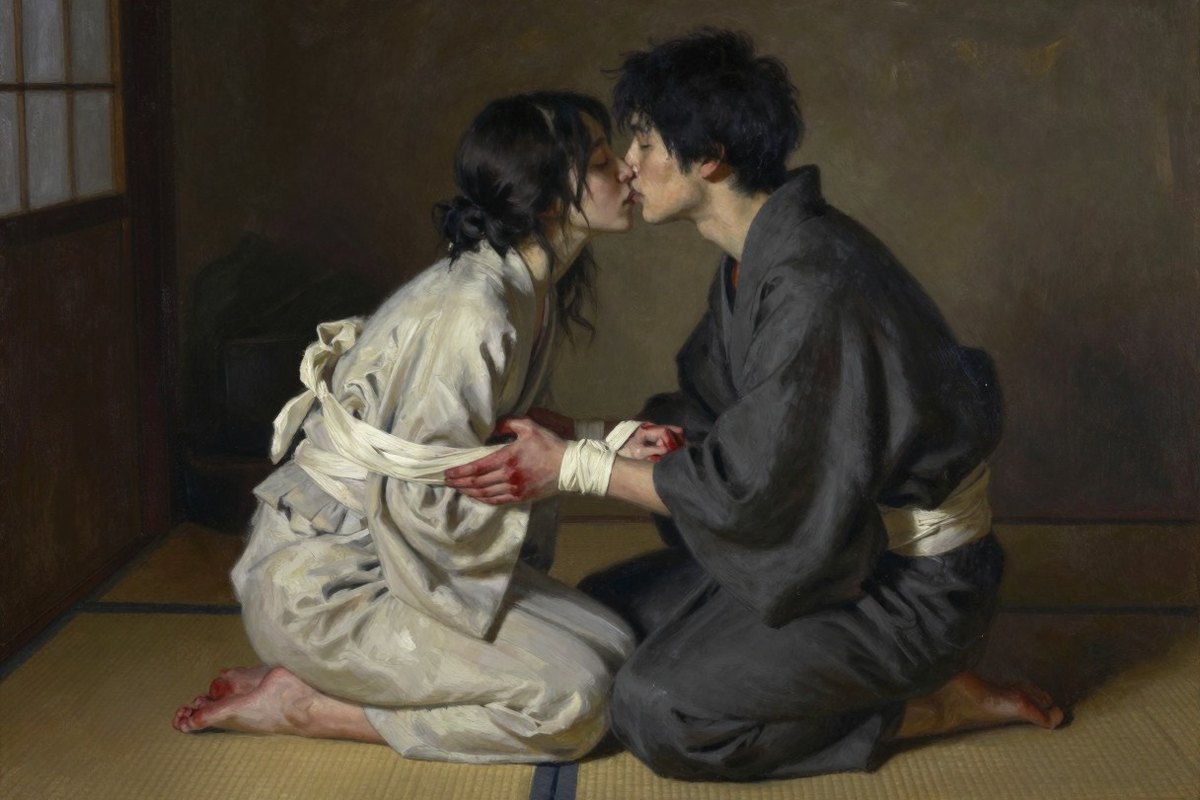
The Bolted Room
The latch clicked, a sharp metal sound that seemed to swallow the rest of the room, and then I was alone with him and the smell of old sake and fresh blood. It wasn’t just that he had arrived; it was the finality of the door sliding shut, the way the wooden tongue of the bolt slid home with a heavy, deliberate *thunk* that told me no one else was coming tonight. The air in the back room grew still, holding its breath, waiting for me to decide if he was worth the hanging that would follow if I got it wrong.
He stood in the center of the tatami, leaning against the low shelf where I kept the guest towels, and let out a breath that shuddered through his whole frame. He was tall, not in the lanky way of the young samurai who paraded near the temple, but in the dense, compact way of a man built for impact. His shoulders were broad beneath a dark indigo kimono that had seen too many winters, the fabric frayed at the cuffs. I looked at his hands first, because that was how I knew a man’s trade. They were large, the knuckles scarred and white at the tips, resting on the hilt of the katana strapped to his waist. He didn’t look at me. He watched the floorboards, his jaw set in a line of quiet endurance, his dark eyes tracking the dust motes dancing in the sliver of light from the window. He was a swordsman, and he was tired, and he was mine for the night.
I did not wait for him to offer thanks or to give me his name. I had taken enough names that night, scribbled in charcoal on the back of a tea order to keep my memory honest. This one was Samir, because he had said it once, quietly, when he handed over the coin for the room, and I had filed it away next to the ledger entry for the sake barrel he would drink from. Now, the coin was spent, the room was paid for, and the only currency left was silence.
I moved to the low table in the corner where the oil lamp sat, its flame guttering slightly in the draft that slipped through the paper screen. One light was not enough. If I was to check for wounds, I needed to see the color of his skin, the direction of the cuts, the way the blood had dried. I struck a match against the rough side of the box, the sulfur smell sharp and sudden, and lit the second wick. The room brightened, pushing the shadows back against the wall, and for a moment he flinched, his hand tightening on the sword hilt.
"Don't," I said, my voice low but firm. "If you are hiding, hide well. If you are bleeding, let me see it."
He looked up then, his eyes adjusting to the doubled light. There was no gratitude in his gaze, only a wary assessment, as if he were measuring my strength. He unstrapped the katana with practiced ease, the leather sliding against the wood of the shelf, and laid it flat on the tatami. The blade caught the light, a long, silver line that seemed to hum in the quiet. He sat cross-legged, his back straight, and I sat opposite him, balancing the small bowl of water and the cloth on my knees.
"Roll up your sleeve," I said.
He hesitated. It was a small thing, a hesitation of pride, perhaps, or just the habit of a man who had spent years protecting his body from harm. But the humidity in Kyoto was heavy tonight, pressing against the room like a wet wool blanket. A wound left to fester in this heat would smell by morning. The soldiers who patrolled the streets had sharp noses; they could smell fear and rot from three houses down.
"Please," I added, not as a plea, but as a statement of fact. "I cannot bind what I cannot see."
He exhaled, a slow release of air, and lifted his right arm. The fabric of his kimono sleeve slid up his forearm, revealing the skin beneath. It was pale, marked by the faint white lines of old scars, but fresh on the inner wrist was a shallow cut, red and angry, the edges slightly raised. It was not deep, but it was clean, sliced by a blade that had meant to do more damage.
I dipped the cloth into the water and wrung it out. I had mixed a pinch of salt into the sake earlier, a trick my husband had taught me for cleaning minor cuts when we were young and foolish, before the merchants’ guild took him and left me with the inn and the debts. The mixture stung, but it killed the infection.
I reached out and pressed the damp cloth to the wound.
Samir did not pull away. His breath hitched, a sharp intake that vibrated in his chest, and his jaw tightened, the muscle feathering beneath his skin. He held still, his dark eyes fixed on my hands rather than his own arm. I watched his face, counting the seconds, feeling the warmth of his skin through the thin fabric of the cloth. He was watching me work, studying the efficiency of my movements, the lack of hesitation.
"You are not afraid of the pain," he said, his voice rough, unused to speaking.
"I am afraid of the smell," I corrected, wiping the blood away in a smooth arc. "And of the soldiers."
He let out a short, humorless breath. "They are not far."
"I know. That is why I am here."
I finished cleaning the cut and reached for the strip of linen I had prepared. My fingers grazed the silk at his chest as I secured the linen. He shivered, a subtle tremor that I felt in my own fingertips. I pulled my hand back, keeping my eyes on the knot I was tying.
"Why did you flee?" I asked, testing the tightness of the bandage. It was not a question I expected an answer to, but the silence between us was growing heavy, thick with the things we were not saying.
Samir looked down at his bound arm, then up at me. The candlelight flickered, casting long shadows across his face, deepening the lines around his eyes.
Free, no account. You will be asked to confirm you are 18 or over.
Or browse the collection