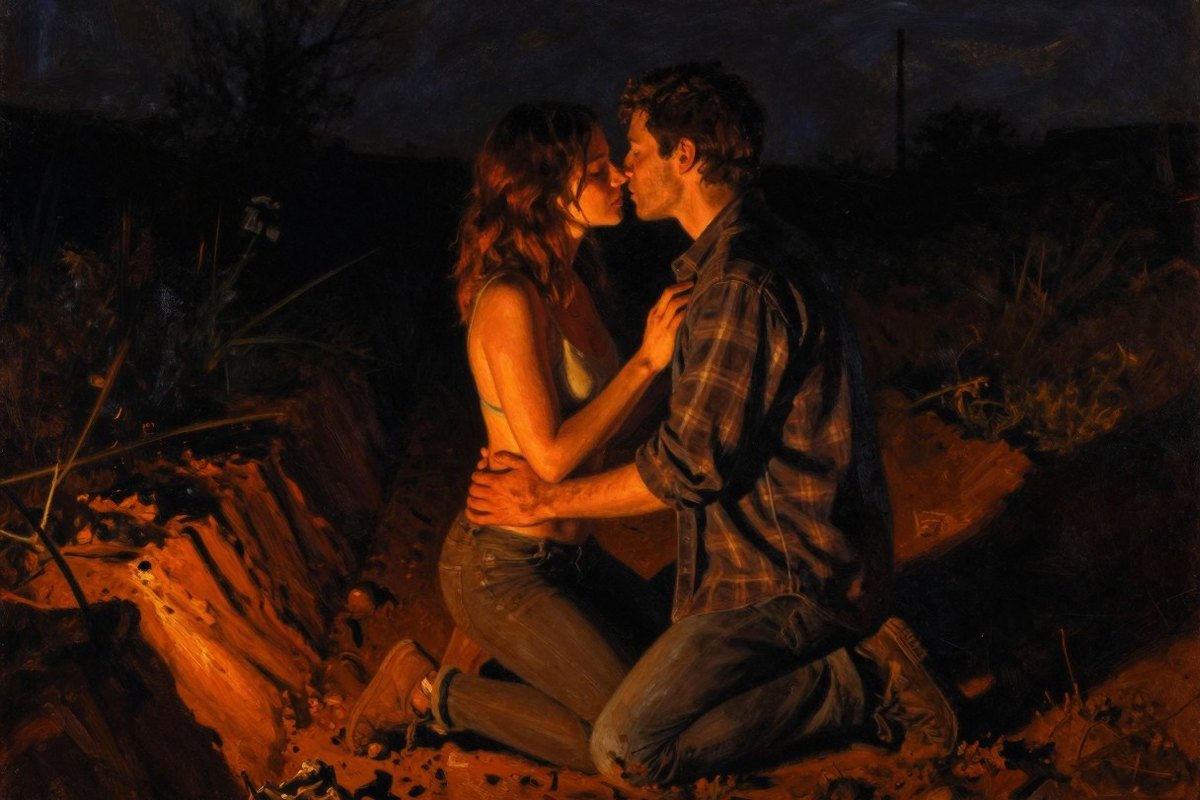
The Beetroot
There were four reasons Nico had not kissed her in three years.
First, he was a neighbor. Neighbors were for borrowing sugar and complaining about the windbreak. They were not for unbuttoning each other’s cardigans in the dark. Second, he was easy. He touched her shoulder when he passed her a trowel, rested a hand on her back to steady her against the rain, and it was all so casual she could not tell if he wanted her or just liked the warmth of another body in the chill. Third, she was forty-seven and tired of pretending that this was anything more than a pleasant summer hobby. And fourth, she was pretty sure he was married.
She stood in the muddy ditch of Plot 4B, shining her torch beam into the black soil, and decided to check on the fourth reason.
Nico was on his knees ten feet away, wrestling a stubborn beetroot from the earth. He wore a flannel shirt the color of dried blood, the sleeves rolled up to reveal forearms that were more hair than muscle. His face was smudged with dirt, a stark contrast to the clean-shaven jawline she had noticed last July when he handed her a ripe tomato, his fingers brushing hers with a deliberate slowness that had made her pulse jump. He cursed under his breath, a low, rough sound that vibrated in the quiet air, and then laughed, shaking his head as the root finally gave way.
He wiped his hands on a rag around his neck, leaving a smear of brown, and looked up. The beam of her torch caught his eyes—dark, warm, and fixed entirely on her.
"You’re staring, Tara," he said, his voice gentle, amused.
"Am I?" She kept the light steady on his face. "I’m counting. It’s a habit."
"Counting what?"
"Reasons why you’re not coming over here and taking me into your shed before the council men arrive with their chainsaws on Monday morning."
He didn’t move. He just watched her, the beetroot forgotten in the mud, and the easy smile softened into something quieter, heavier. The air between them, usually filled with banter about compost and pests, suddenly felt charged, thin and electric. He stood up, brushing the dirt from his knees, and took a single step toward her.
"Is that a request?" he asked.
She held his gaze, feeling the familiar flutter in her chest, the one she usually ignored. "It’s a fact. You’re the only one left."
He did not step closer. He let the space between them hold its breath, the kind of stillness that only exists when two people are waiting for the other to make the first move. The Leeds fog pressed against them, damp and heavy, smelling of wet earth and diesel from the distant road. It was the smell of an ending, sharp and final.
"I am not married," he said. It was not a joke. It was a statement of fact, delivered with the same calm certainty he used when telling her which way the wind was blowing. "And I have been watching you bend over these potatoes for three years, Tara. It is hardly a secret."
She felt the heat rise in her neck, not from embarrassment, but from the simple pleasure of being seen. She liked men who looked. It meant they were present. But Nico was different. He didn’t just look; he registered. He noticed the way she wiped her hands on her jeans, the way she tucked a stray curl behind her ear when she was concentrating, the way she always saved the smallest, crookedest tomatoes for him because she knew he liked the challenge of eating them.
"Three years is a long time to memorize a back," she said, her voice dropping to match the quiet of the allotment.
"Time moves differently when you are waiting," he said.
She looked at the shed behind him, a small wooden structure that had become a sanctuary over the last few summers. Inside were the tools they had shared, the jars of seedlings they had started together, the ghost of every conversation they had had while standing shoulder to shoulder in the rain. It was a domestic intimacy they had built without meaning to, brick by brick, row by row. Now it was going to be flattened. The council didn’t care about their shared history. They only cared about the square footage.
"We have the onions left," she said, shifting the beam of her torch toward the raised bed where the last of the crop huddled in the mud. "And the boxes."
"I know," Nico said. He didn’t move toward the bed. He stayed where he was, close enough that she could see the flecks of gold in his dark eyes, close enough that she could smell the soap on his skin underneath the dirt. "But the onions can wait five minutes."
"They can’t," she said, though she made no move to step away. "Monday morning. The bulldozers don’t care about five minutes."
"Neither do I," he said softly. "Not for the onions."
She laughed, a short, bright sound that cut through the fog. "You’re impossible. You’ve spent all summer telling me to save the seed potatoes, to protect the roots, to be careful. Now you’re telling me to ignore the harvest."
"I’m telling you to look at what’s in front of you," he said. He finally moved, stepping into the circle of her light. He reached out, not for her, but for the torch in her hand. His fingers brushed hers, warm and calloused, and he took it from her, turning it off.
Total darkness fell, heavy and absolute, pressing against them until only the sound of their breathing remained. The city lights of Leeds were a distant glow on the horizon, but here, in the plot, there was only the blackness and the sound of their breathing.
"Now," he said, his voice right beside her ear. "Look at me."
She couldn’t see him, but she could feel him. The proximity was overwhelming. He stepped into her space until the air between them grew warm, his weight settling against the silence. It was a small distance, but it felt like a mile. She had spent three years maintaining the boundary of neighborly politeness, a thin line drawn in the mud. Now, in the dark, the line had dissolved.
"Where are you?" she asked, her voice barely a whisper.
"Here," he said. "With you."
She reached out, her hands moving blindly in the dark. She found his arm, the solid muscle beneath the flannel, and held on. It was a deliberate touch, a decision made in the dark. She wasn’t afraid. She was curious. She wanted to know what he would do with the control she was handing him.
He didn’t pull her in. He didn’t rush. He simply let his hand cover hers on his arm, his thumb stroking the back of her knuckles in a slow, rhythmic motion. It was a small gesture, but it felt like a promise.
Free, no account. You will be asked to confirm you are 18 or over.
Or browse the collection