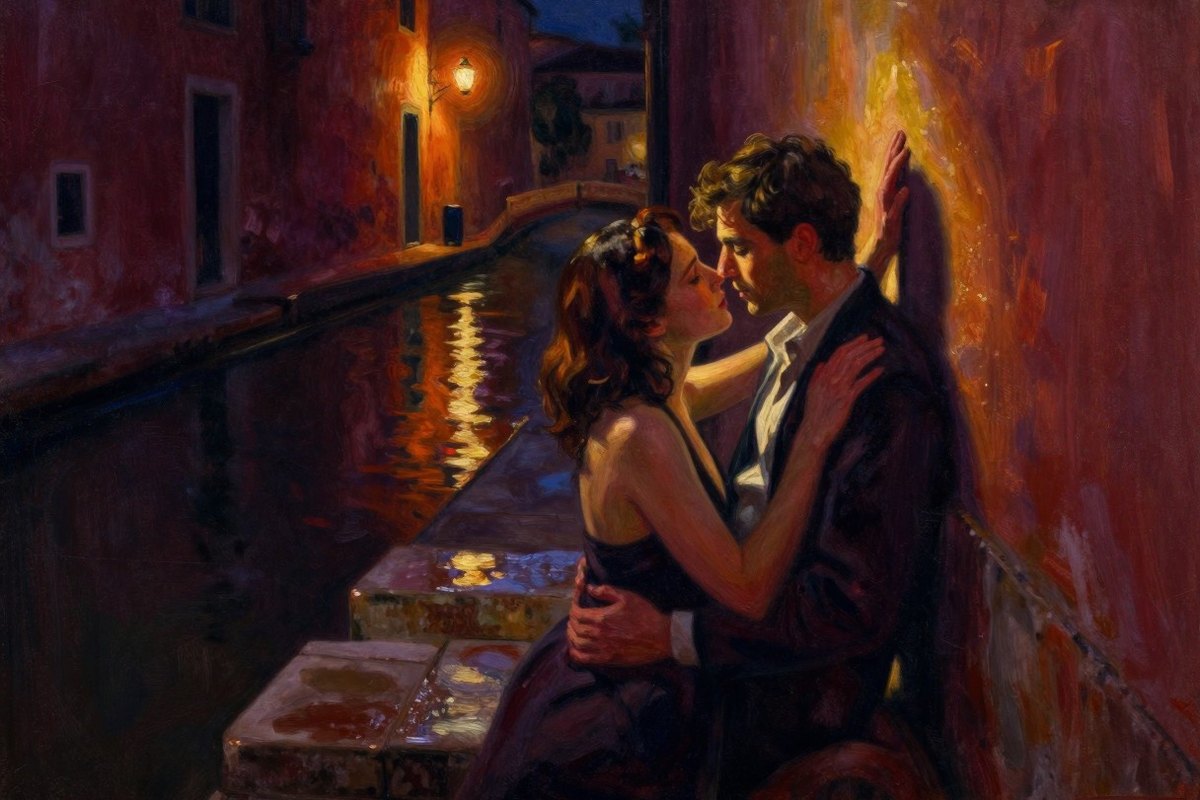
The Architecture of Leaving
The applause is still ringing in my ears, a dull, percussive thrum against the inside of my skull. I am standing on the marble landing of the Hotel Gritti’s private water stairs, the heavy oak door of the hotel lobby closed behind me, shutting out the clink of glasses and the low roar of the gala. The air here is different—heavier, smelling of wet stone and stagnant canal water. It is 11:55 PM. I have four minutes to breathe before Matt arrives.
I check my watch. The crystal is smudged. I wipe it with my thumb, a nervous tic I’ve had since I was twenty, though I am forty-four now and I own a Patek Philippe. I don’t take it off. I need to know the seconds are moving.
The ceremony went according to plan. My first feature, *The Architecture of Leaving*, won the Golden Lion for Best Narrative. I gave a three-minute speech. I thanked my editor, my cinematographer, and my mother. I did not thank him. He sat in the front row, wearing a tuxedo that looked too expensive and a face that looked too tired. He didn’t clap. He just watched me, his eyes dark and unreadable in the theater’s dim light, until I walked up to the stage.
He is the man the film is about. He is the reason I have a list of seventeen specific ways to ruin a relationship, and the reason I am standing here waiting for him to show up. I don’t know he’s coming until tonight. The producer told me, casually, over champagne, that Matt had been hired to present the award for Best Cinematography. I didn’t know he was presenting. I didn’t know he was in the room.
A small boat bumps against the stone steps below. The engine cuts. The water laps, black and oily, against the limestone. I look down. He is standing on the gunwale, his silhouette cut from the moonlight. He is taller than I remember, or maybe the perspective is just cruel. He is wearing a dark shirt, sleeves rolled up to the elbows, forearms corded with muscle that looks like it’s been used to lift things heavier than awards. His hands are resting on the gunwale, knuckles white. He is not smiling. He is waiting.
I do not wave. I do not call out his name. I simply step down from the landing, my heels striking the worn limestone with a sharp, rhythmic click that echoes off the water. The air is thick with the smell of decay and salt, the specific perfume of Venice when the tide is high and the city is holding its breath.
Matt steps off the boat onto the lowest step. He doesn’t move to help me down the remaining three. He just stands there, hands deep in his trousers pockets, his posture relaxed but his eyes fixed on me with an intensity that feels physical. It is a look I know well. It is the look he gives when he is trying to decide if I am worth the trouble.
"You’re early," I say. It is not a question. It is an observation.
"I’m punctual," he corrects. His voice is low, roughened by the smoke he definitely smoked on the way over, and by the silence of the last three years. "You said midnight. It is midnight."
I reach the bottom step and stand on the narrow stone ledge, the water lapping at the hem of my dress. It is a simple black slip, nothing for the camera, nothing for the critics. Just fabric and skin. "You didn’t have to come," I say. "The award is in my hotel room. I have a bottle of water waiting for me. I have a schedule for tomorrow morning."
"I know," he says. He shifts his weight, the movement subtle, but I see the tension in his jaw. "I have the script. I read the ending last night."
The words hang between us, heavy and deliberate. *The script.* Not the film. The raw footage. The cuts. The things I threw away.
"And?" I ask. My voice is steady, but my pulse is hammering against my ribs like a bird trapped in a drawer.
"It’s right," he says. He looks out at the canal, where the reflection of the palace lights shimmers in broken ribbons on the black water. "The way you cut it. The way you left me walking away before you turned around. It’s right."
I feel a small, sharp pain in my chest. It is not surprise. It is the sensation of a door closing that I thought was already shut. "It wasn’t about leaving," I say. "It was about staying."
"I know," he says. He turns back to me. His eyes are dark, the irises nearly black in the low light, but I can see the flecks of gold around the pupil, a detail I noticed the first time I saw him in this city, eight years ago. "I stayed. You didn’t."
"I was busy building a life," I say. The defense is automatic, rehearsed in the quiet hours of editing suites and hotel rooms in London and New York. "You wanted a life that was just us. That’s not a life, Matt. That’s a vacation."
He doesn’t argue. He never does. He deflects with silence, letting the statement settle until it becomes truth by default. He takes a step closer. The space between us shrinks, the air growing warmer, charged with the static of old arguments and newer desires.
"You built it," he says softly. "I saw the film. You’re very good at building things, Gillian. You put everything in its place. You measure twice. You cut once." He pauses, his gaze dropping to my mouth, then back to my eyes. "But you forgot to leave a place for the mess."
"The mess is what made the film," I say.
"No," he says. "The mess is what’s still here."
He reaches into his pocket. I brace myself, expecting a gift, a note, something tangible to hold. Instead, he pulls out a single, crumpled receipt. He holds it out to me, his fingers long and steady.
I look at it. It is a receipt from a coffee shop in Dorsoduro. The date is three years ago, two weeks after I moved back to London. *Two espressos. One cortado.*
"I came back," he says. "I waited for you. You weren’t there."
"I had a screening," I say. "I was late."
Free, no account. You will be asked to confirm you are 18 or over.
Or browse the collection