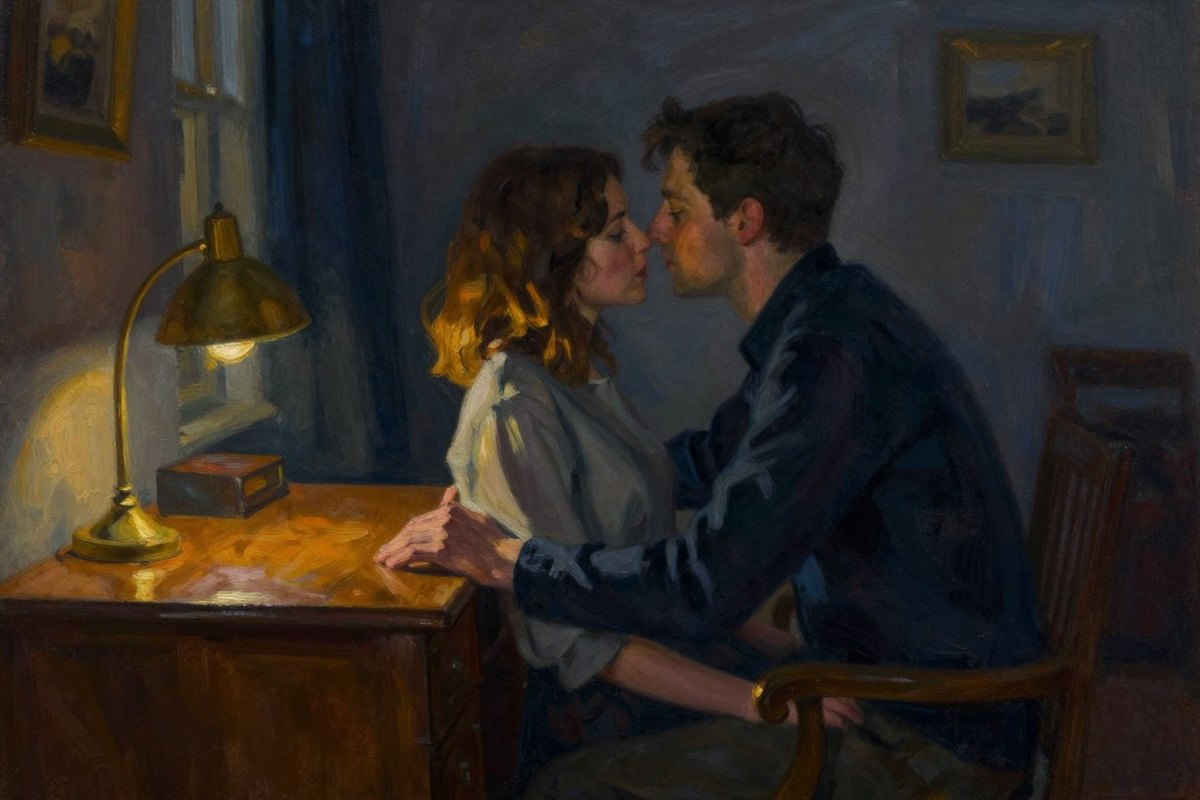
Tactile Data
I decided that if I did not break Will Thorne before seven o’clock tomorrow, I would stop pretending to be an archaeologist and start working at a tea shop. It was a reasonable threat. The Parthenon marbles had spent two hundred years in the British Museum; I was tired of them, and I was tired of the man who guarded them like a dragon sitting on a pile of old stones.
We were stuck in the same guest wing of St John’s College, a narrow corridor smelling of floor wax and damp wool. The debate was live in twenty-two hours. He was on the other side of the shared sitting room, sitting in a leather chair that looked older than both of us, reading a dossier with his glasses sliding down his nose.
He was not what I expected. I had imagined a tweed-wearing academic with a stiff collar and a stiffer mind. Instead, he was broad-shouldered and loose-limbed, wearing a grey sweater that clung to the heavy muscle of his back. His ink-stained fingers dragged across the page with a languid heaviness that felt like a personal slight. He did not look up when I entered. He just kept reading, his jaw set in a line that suggested he was already winning an argument in his head.
I set the glass down. The condensation ringed the wood.
“You’re arranging index cards,” I said. “In 2024. It’s aggressive.”
Will finally looked up. His eyes were dark, unblinking. He didn’t smile. “I prefer tactile data to digital ghosts. You’ll find my organization superior to your passion.”
“My passion is peer-reviewed. Your organization is quaint.” I walked to the opposite side of the room and dropped my bag on the sofa. It landed with a thud. “I’m reviewing my stratigraphy notes. If you’re going to sit there breathing heavily, at least make yourself useful.”
He stood up. He was taller than he looked sitting down. He moved to the center table, where I had spread out my own scattered papers. He didn’t ask permission. He picked up a stack of my notes, his fingers brushing mine. His skin was warm, dry. He let his hand rest there, heavy and still against mine.
“Page four,” he said, his voice low. “You claim the chisel marks on the frieze match the quarry at Mount Pentelicus. But you’re ignoring the tool wear on the drapery folds. It’s a later restoration, Hazel. Not original.”
I stared at him.
I didn’t blink. I watched his hand hover over the paper, the ink on his thumb smearing slightly against the crisp white edge.
“You’re looking at the drapery of the CalfBearer,” I said. “Not the horseman next to it.”
Will’s eyes flicked to the diagram, then back to me. The air in the room shifted, the dust motes seeming to hang stiller. “The CalfBearer is fragmented. The restoration work from the 1840s is clumsy. It’s why the marble looks soft.”
“The softness isn’t clumsy,” I said, stepping closer. I was close enough to smell the faint scent of old paper and cedar on his sweater. “It’s the weathering of two hundred years in a damp London attic. You call it restoration error. I call it history breathing.”
He looked down at me. His gaze was heavy, assessing, stripping away the academic pretense to look at the woman standing in his space. “You’re arguing for sentiment,” he said quietly. “I’m arguing for chronology.”
“Chronology is just a timeline,” I said. “Sentiment is why we care.”
He didn’t move. He just watched me, his dark eyes locking onto mine with an intensity that made the back of my neck prickle. He reached out, not for the paper, but for the space between us. His fingers, large and rough, brushed the side of my neck, tracing the line of my jaw with a deliberate, slow pressure that felt like a claim.
“Prove it,” he murmured, the sound vibrating against her skin. “Show me the history breathing.”
He didn’t move his fingers from my jaw. His thumb slipped between my lips, and I opened for him. “You want me to prove it,” I said, “or you want me to beg?”
Free, no account. You will be asked to confirm you are 18 or over.
Or browse the collection