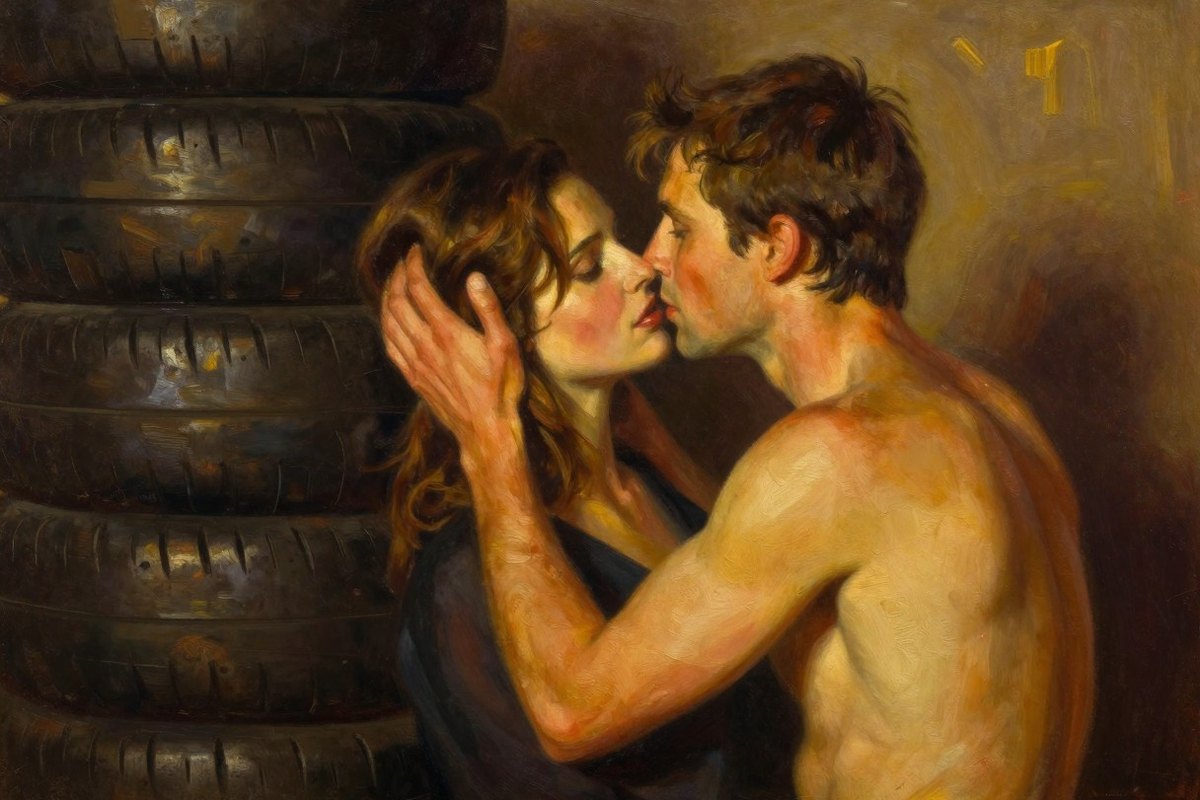
Proof by Nine
The shutter click was louder than the crowd. It wasn’t a polite snap; it was a mechanical *crack*, like a bone breaking in the quiet of the garage bay, followed immediately by the hiss of the rival team’s lead photographer adjusting his lens.
I froze. Not because I was cold—though the morning air in Monte Carlo always felt damp and heavy, like a wet wool sweater stuck to your skin—but because I saw Andrew. He wasn’t looking at the camera. He was looking at me, his head tilted slightly to the left, his dark eyes narrowed in that specific way that meant he was calculating the angle, the lighting, and probably my exit strategy all at once.
We had just walked out of their garage. Together. With his hand in my hair.
“You’re standing in the light,” I whispered, though we were already halfway to the paddock. “If you want proof, I need to be seen. Not backlit.”
Andrew didn’t answer. He just stepped closer, closing the gap between us until his chest brushed my shoulder, his presence solid and warm against the chill. He smelled like engine oil, expensive soap, and the faint, metallic tang of the carbon fiber he spent his days handling. His hand, large and calloused from years of wrenching on high-torque bolts, lingered on the back of my neck, his thumb pressing lightly into the sensitive skin there. It wasn’t a caress. It was an anchor.
“Hold,” he said, his voice low, barely audible over the high-pitched whine of the electric cars warming up. “Don’t move.”
I looked at him then, really looked. He was tall, broader than he needed to be, with the kind of lean muscle that came from lifting heavy things for a living. His knuckles were scarred, the skin rough, and he wore a simple black mechanic’s jacket that had seen better days. But it was his stillness that unsettled me. While I talked, he watched. And right now, he was watching me with an intensity that felt less like a performance and more like a promise.
Qualifying was at nine. We had four minutes.
Four minutes felt like a luxury when you were thirty-five and running on four hours of sleep and too much espresso, but I treated it like a countdown to detonation. I needed to be messy. I needed to be loud. I needed to be the woman who didn’t care if her hair stuck to her forehead with sweat because she’d been pinned against a tire stack by a man who knew exactly where her data wires crossed.
“Move,” I said, shoving his shoulder. It was a hard shove, the kind that would bruise a normal guy, but Andrew just absorbed it, shifting his weight with a grace that was frankly insulting for a man who spent his days wrestling with stripped bolts. He didn’t look annoyed. He looked amused. That was new. Usually, people got annoyed when I touched them. They cut me off mid-sentence. They got annoyed when I existed in their space with the subtlety of a forklift. Andrew just watched my hand drop back to my side and nodded, as if I’d passed a test I hadn’t known I was taking.
“Too clean,” he said. His voice was gravel, low and rough. “You look like you’re posing for a catalog. ‘Data Engineer by day, Mechanic’s Muse by night.’ Boring.”
“I am not a muse,” I snapped, my voice rising an octave. I loved the noise of the paddock; it was a chaotic symphony of pneumatic drills, shouting engineers, and the sharp, metallic scream of carbon fiber spinning up. It matched the noise in my head. “I am a threat. A loud, caffeinated threat. And right now, I am bored. So are the cameras. Give me something to photograph, Andrew.”
He stepped into me then, not with the gentle proximity of before, but with a sudden, heavy invasion of space. He grabbed my waist, his fingers digging into the fabric of my team jacket, and spun me around. My back hit the rough, rubberized surface of the stacked tires. The smell of hot rubber and old oil hit me, sharp and intoxicating. He didn’t let me breathe. He didn’t give me a second to adjust my posture or smooth my hair. He pressed his hips against mine, solid and unyielding, and I felt the hard line of his body map itself against mine.
“Look at me,” he ordered. It wasn’t a request. It was a command, delivered with a flat finality that stopped my breath in my throat.
I looked up. His face was inches from mine.
His eyes were dark, focused on the space between my eyebrows, scanning for the angle. He didn’t look at my face; he looked at the geometry of us. That was the thing about Andrew. He didn’t see *Mia, Loudmouth Engineer*. He saw leverage. He saw structure. It was infuriating. It was magnetic.
“Chin up,” he murmured. “Shoulders back. You’re slouching like you’re trying to hide.”
Free, no account. You will be asked to confirm you are 18 or over.
Or browse the collection