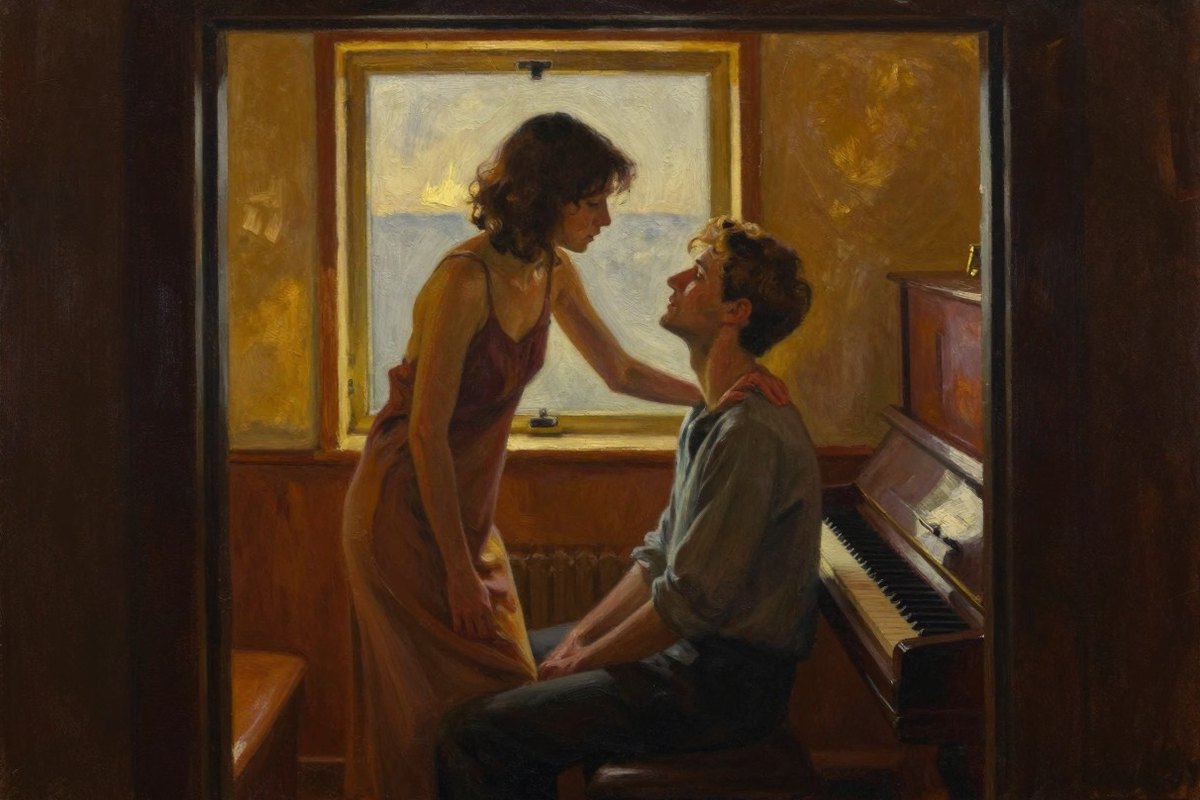
La Valse d’Amélie
The air held the sharp sting of industrial cleaner and the flat warmth of cheap gin. It was 4:15 a.m., two hours before the gangway dropped into Bergen. The ship was a hollowed-out bone, humming with the low vibration of engines slowing for the fjord.
I stood by the grand piano. Euan was inside the fallboard, tuning the A-string.
He was the pianist. I was a guest. We did not mix. It was the first rule of the cruise line, printed in bold on the crew contract and whispered by the bartenders. Guests paid for the illusion of separation; crew provided the labor to keep it clean.
I had taken this trip alone. My husband, Mark, had stayed in London for a merger closing. I had bought his ticket, then sold his half back to the agency, keeping the suite. At thirty-nine, I was used to winning the deal and losing the partner. The job mattered. The merger would be signed tomorrow morning. This was just the commute.
But Euan had played "La Valse d'Amélie" every night for the last six days. He played it when I was staring into my champagne, when I was checking my emails, when I was pretending to read a guidebook about Norwegian history. He played it like he knew I was listening. Like he knew I was empty.
I watched his hands. They were large, dark-haired, and surprisingly gentle against the ivory. He didn't look up. He never did. He just played, and I listened, and the silence between the notes felt like a question I hadn’t answered yet.
He struck the final chord, letting it ring until the vibration faded into the hum of the hull. He didn’t look up immediately. He let the silence settle, heavy and expectant, before he finally turned his head.
His eyes were dark, warm, and fixed on me. Not at my glass, not at my face, but directly into my eyes.
"Why this song?" I asked. My voice sounded too loud in the empty room.
Euan smiled, a slow, easy curve of his lips that reached his eyes. "You hum it," he said. "When you’re thinking. When you’re angry. When you’re pretending you don’t care. It’s in your head, Debbie. I can hear it."
The hum died in my throat. I *did* hum it. In the shower. In the elevator. When I was finalizing the port rights agreement on my tablet, trying to outmaneuver the rival firm Mark’s brother owned. It was my stress signal. My private frequency.
And he had been broadcasting it back to me for six nights.
"Is it a bad song?" I asked, stepping closer. The distance between me and the piano bench closed from ten feet to five.
"No," he said. "It’s just lonely. Like you."
I should have walked away. The contract needed a final review. The Bergen partner was notoriously punctual, and if I wasn’t sharp, the leverage would slip. But the air in the lounge felt thick, charged with something that wasn’t just the recycled oxygen of the ship. It was want. Plain and simple.
"Play it again," I said.
He nodded. His hands hovered over the keys.
"But this time," I added, "look at me. Don’t look at the keys. Look at me."
He didn’t hesitate. He began to play, his fingers heavy with purpose, his gaze locked on mine. The melody unwound, familiar and sweet, but under his fingers, it felt heavier. More intentional. He wasn’t just playing notes; he was holding a space for me.
I watched his hands move, graceful and strong. I watched the way his shoulders relaxed into the music, the way his brow furrowed slightly in concentration. It was intimate in a way that had nothing to do with sex and everything to do with attention. He was giving me his full, unbroken attention, and for the first time in weeks, I felt seen.
When the last note faded, he didn’t stop. He kept his hand resting on the high C, waiting.
"Why are you alone, Debbie?" he asked. His voice was low, rough around the edges. "This is a honeymoon cruise. The suites are expensive.
“You’re paying for two, but you’re drinking for one.”
It wasn’t an accusation. It was an observation, delivered with the same steady rhythm as the music.
I took a sip of my gin and tonic, the ice clinking against the glass. The sound was sharp in the quiet. “My husband wasn’t coming,” I said. I didn’t offer the details. The divorce was final, the assets were split, and the itinerary was booked. It was a logistical error, not a tragedy. “He had a conference in Oslo. I had a contract to sign in Bergen. We agreed to meet in the middle. He didn’t make it.”
Euan’s fingers lifted from the keys. The silence rushed back in, but it didn’t feel empty anymore. It felt suspended.
“So you’re alone,” he said.
“I’m focused,” I corrected. “It’s precision.”
“Is there?” He stood up.
Free, no account. You will be asked to confirm you are 18 or over.
Or browse the collection