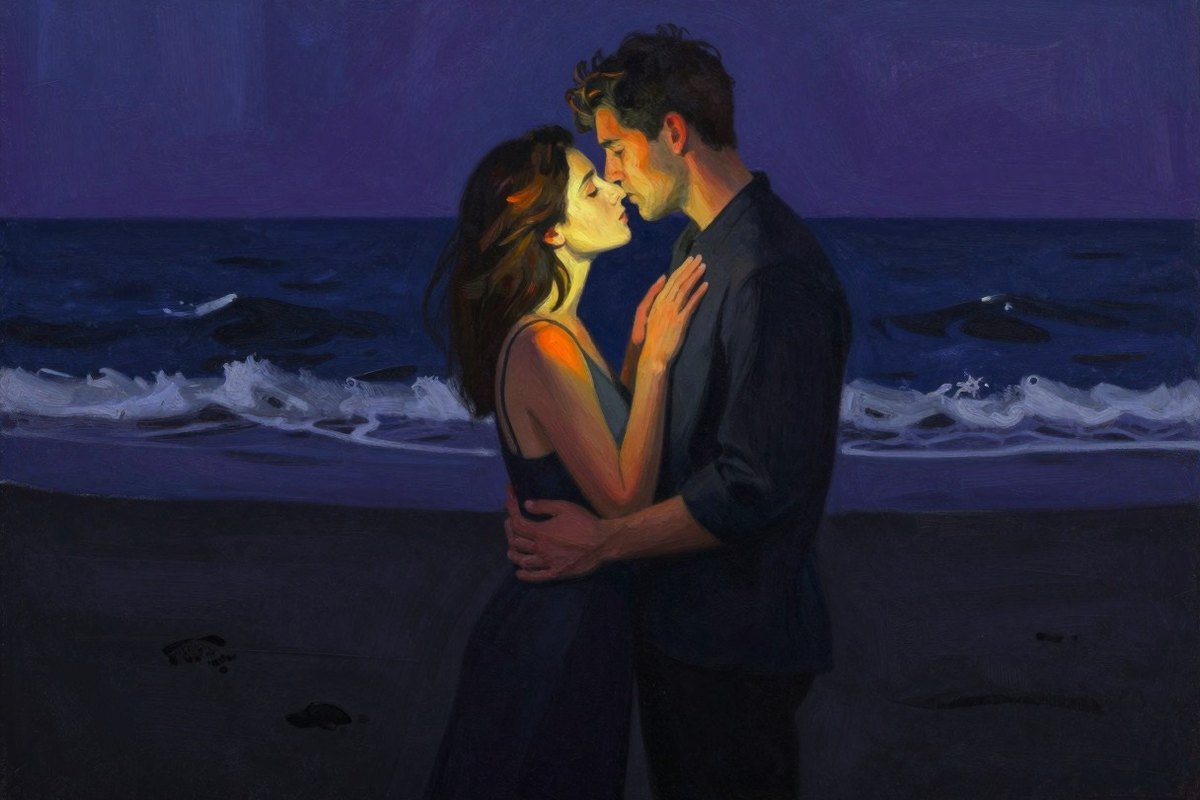
Black Sand Tide
“Stop looking at the sea lions like they’re your copy editors, Javier. They have better taste.”
The diesel engine of the tender coughs, shudders, and dies, leaving us drifting in a circle of warm Pacific water off the black sand beach of Santa Cruz. It is day three of the press trip, and we are stranded. The only other humans within a mile are the tour guide, who is already on the satellite phone, and the three of us in this rubber boat. Javier, my rival at the magazine, my enemy in the letters column, the man who called my last book “a travelogue written by a tourist with a thesaurus,” is sitting on the gunwale, water dripping from his expensive linen shirt onto his bare thighs.
He doesn’t look at me. He’s watching a hundred-pound sea lion haul itself onto a rock, shaking its head like a wet dog. Javier is broad-shouldered, built like someone who lifts heavy things rather than just carrying them, with forearms corded in muscle and sun-browned skin that looks ridiculous against the stark white of his collar. He has a habit of chewing the inside of his cheek when he’s thinking, a tiny tic I’ve noticed in every photo shoot we’ve shared for the last two years.
“Well,” he says, finally turning his dark eyes on me. “If they don’t like your metaphors, at least they won’t charge you by the word count.”
“I’m not stranded because of my metaphors, Javier. I’m stranded because the captain bought the engine at a flea market.” I grab the oar. “Give me a hand, or do you only help when it’s for a photo op?”
He smiles, slow and infuriating, and takes the other oar. The wood is slick under his palm. Up close, he smells like salt and expensive scotch, a scent that usually means trouble. Right now, it just means I have to row next to him.
We don’t speak until the oars hit the wet black sand with a heavy, sucking thud. The silence that follows the engine’s death is absolute, broken only by the rhythmic, wet exhales of the sea lions. They are everywhere. Not just on the rocks, but spread across the beach like a colony of oversized, tanned seals, their whiskers twitching, their eyes half-closed in indifference to our arrival.
Javier hops out first, his boots sinking immediately into the sludge. He looks back at me, extending a hand. It’s a reflex, not a courtesy. He knows I won’t take it. I step out on my own, the cold water rushing up to my calves, the weight of my press kit bag dragging at my shoulder. I haul it onto the sand, leaving a perfect rectangular footprint in the dark grit.
“Your book,” I say, kicking a small shell toward him. “*The Slow Lane*. Page forty-two. You wrote about the smell of wet wool in a Patagonian hostel. It was good. But it was also lazy. You let the atmosphere do the work instead of the narrative.”
Javier laughs, a low sound that doesn’t seem to fit the vast emptiness around us. He drops his bag next to mine. “And your last piece on Kyoto was structural perfection. A grid. Beautiful, rigid, and utterly devoid of surprise. I said it was written by a tourist with a thesaurus because tourists look for structure. Locals look for chaos.”
“I’m not a tourist,” I snap, though the wind is picking up, carrying the sharp tang of guano and kelp.
“No,” he says, adjusting his glasses which are suddenly fogged. “You’re a editor in disguise. You want the world to fit in a column inch.”
He reaches for his windbreaker, shrugging out of it. The movement exposes the line of his neck, the pulse jumping there. He holds the jacket out to me. It’s an olive-green canvas thing, oversized, smelling faintly of his cologne and the salt air.
“Put it on,” he says. “The sun’s down. It’s going to get cold fast.”
I look at the jacket. Then I look at him. He’s not smiling anymore. His gaze is direct, stripped of the performative rivalry we’ve maintained for three days. There’s a heat in it that has nothing to do with the dying sun.
“Why?” I ask. “To prove you’re the generous rival? To win the sympathy vote in the next issue?”
“Because you’re shivering,” he says simply. “And I’m not cold enough to care about winning.”
I take the jacket. It’s heavy, warm from his body, and smells like him—cedar and sweat and that expensive tobacco he only smokes when he’s thinking. I pull it on. It swallows me, the sleeves hanging past my wrists, the hem brushing my thighs. It feels like a surrender I didn’t agree to, but my teeth are chattering, so I let it happen.
“You’re freezing,” he says. He doesn’t step back. He stays close, crowding the thin margin where I keep my defenses up. His hand comes up, not to touch my face, but to brush a stray lock of hair from my forehead. His fingers are rough, calloused from years of hiking and climbing, and the contact is electric, a static shock that makes me pull back instinctively.
“Don’t,” I warn, though I don’t move away. “I don’t need your pity, Javier. And I don’t need your charity.”
“It’s not pity,” he says, the gravel in his tone scraping against the quiet. “It’s observation. You’re a writer who cares about the texture of the world, Esther. But you’ve never let the world touch you. Not really. You describe the heat, but you don’t feel it.”
Free, no account. You will be asked to confirm you are 18 or over.
Or browse the collection